
When a Technology Partnership Is Ready to Sign
An overseas technology partnership can look promising. Before committing, the business needs clear rights, a funding plan, and people who can carry out the work.

The short version
- The review looks past the offer to who owns the partner, who owns the technology, and what the business can actually use.
- Current rules and proposed changes need separate review. The U.S. proposal would not cover every biotech deal.
- Open conditions need a named owner, agreed evidence, and a deadline before the next commitment.
The forecast is ready. Is the deal ready as well?
In an illustrative scenario, a manufacturer is about to sign a tech partnership overseas. The pilot succeeded, and the finance team expects a good return. The draft deal is nearly ready.
During the final review, someone asks whether the supplier actually owns all the tech. One person spots a U.S. investor in the funding. Operations expects access to the process data, but the draft license does not mention it. Everyone has put in the work, but their assumptions don't quite line up.
OSVARD's assessment brings those conversations together before anyone commits. The expected return matters, and so does making sure the business can carry out the plan.
The rules behind a workable arrangement
Current rules and proposed changes need separate places in the review. For example, on 22 October 2026, the U.S. Treasury proposed expanding its Outbound Investment Security Program to include certain biotechnology activities. The proposed expansion concerns certain U.S.-person investments involving covered foreign persons and technologies. It is a proposal, with final regulations and an effective date to follow. It would not restrict every biotechnology deal.
The current rules have applied since 2 January 2025. They cover certain U.S.-person investments involving covered persons linked to China, including Hong Kong and Macau, in specified semiconductor, quantum, and AI activities. The team needs to check current requirements now, while the expansion is still under discussion.
The record can identify which rules apply today and which proposed changes warrant another review. That keeps the deal’s timetable connected to the actual requirements.
Three decisions before signing
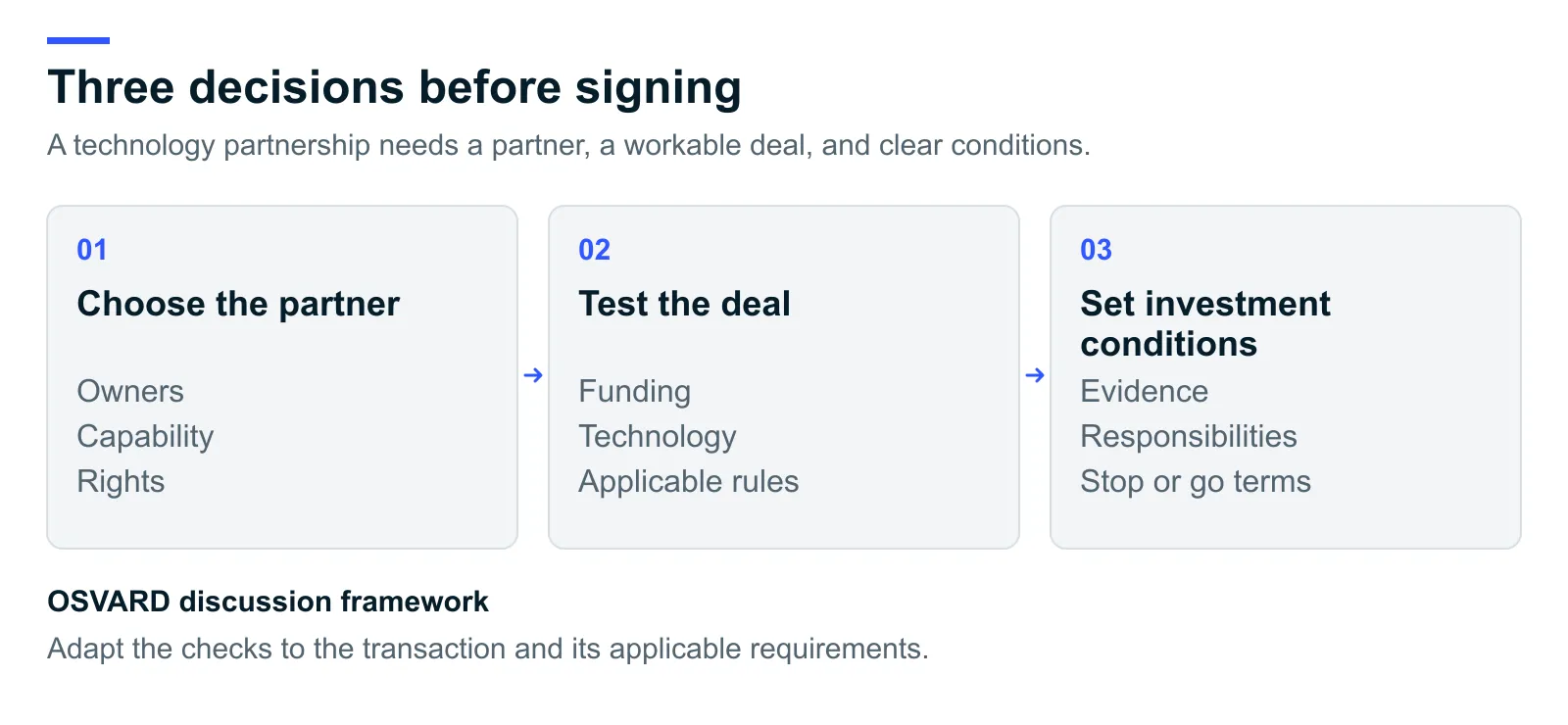 Open figure at full size (opens in a new tab)
Find the partner behind the presentation
In the example, the company presenting the technology may employ the sales team. A subsidiary could own the patents, and another business could receive the investment. The partner needs to explain how those entities are linked. The review also needs to establish who actually owns or controls them and how that control operates.
The next question is what the business actually does. A business described as "biotechnology" could be an equipment seller, a process developer, or a company with several activities. The review also needs to identify the intended users and uses. The company name, address, and sector cannot answer those questions on their own.
The team should record the key answers while the partner is still available to explain them. After the money has been transferred, it will be a lot harder to track down the missing information.
A successful pilot leaves some questions open
Did the pilot use the same raw material and conditions as in the business plan? What still needs to be tested at commercial scale, and who will pay for it? A good pilot result may justify another test. It does not guarantee that the full-scale operation will work as planned.
The team also needs to examine the license. WIPO distinguishes a license to use intellectual property from an assignment that transfers ownership. The review should establish where and how the business may use the technology, which data and know-how it can access, and whether it can modify the process.
The parties need to agree who will own any improvements and who will be the point of contact for support if the supplier is sold. A low license fee offers little benefit if the operating team cannot obtain the information needed to keep production running.
Follow the money before choosing the structure
The funding plan belongs beside the group structure. Does an investor control another entity that will invest? Who takes the decisions? Advisers need to establish what each U.S. connection means for this arrangement. Under those rules, a U.S.-person bank does not, without additional facts, itself undertake a covered transaction merely by transferring funds. The underlying deal still needs its own assessment.
Under Treasury's current guidance, certain equity investments, joint ventures, and certain types of debt can be covered transactions. Ordinary licensing, consulting, or procurement contracts may fall outside that definition. The actual arrangement still needs review for coverage and possible evasion.
The proposal treats ordinary contracts differently from technology transfers. The team needs to review its assessment when the final rule is published rather than assume that today’s conclusion will still apply.
Qualified experts need to look at the arrangement before it becomes difficult to change. Those experts should assess export controls and sanctions separately from the investment rules.
Make the next commitment clear
At this stage, some of the questions should already be answered. Others may still require further testing, further documentation, or a regulatory decision. The parties should agree which issues to settle before signing and which conditions to meet before closing, payment, or technology transfer.
For each condition, the parties need to assign responsibility to someone and agree on what evidence will satisfy it. The work and its cost belong in the schedule. Simply saying "subject to approval" leaves unanswered who will apply, who will pay, and how long the business can wait.
Suppose the partner gets a new owner before closing. Who tells the rest of the team, and when do they look again? The parties need to agree how to respond to a new owner, a different investor or intended use, or a change in the rules. The deal may have to pause, change, or end. Its contract cannot permit prohibited conduct.
Evidence before the next commitment
| Question to settle | Evidence or condition to agree |
|---|---|
| Who is the partner? | An up-to-date ownership and control map, with the relevant operating entities identified. |
| Will it work under the intended conditions? | A test record lists the conditions used. It says what remains to be shown and who will pay for that work. |
| Can the operating team run it? | The agreed terms let the team obtain the data, know-how, and support needed to run the technology. They also address rights to improvements. |
| Which rules affect this arrangement? | The review identifies which rules apply to this deal and what steps are still required before it proceeds. |
| What happens before the next payment? | The record lists the conditions still open. Beside each one, it gives an owner, evidence, a review date, and how a change will be handled. |
Bring the answers back to the forecast
The financial model now needs realistic costs for testing, approvals, and support. It needs to show how delays or unresolved issues would affect the return, with clear assumptions.
Decision-makers need evidence that the partner fits the plan and a clear account of the work still required. They may proceed, change the terms, start with a smaller commitment, or walk away. The forecast should reflect the deal the team can deliver.