
The Death Valley of Brand-new Technology Development.
A promising laboratory result needs a credible route to a workable process. Consider scale, operating constraints and economics while the design is still flexible.

The short version
- Laboratory performance is one part of a commercially useful process.
- Pilot studies should examine the conditions that matter at larger scale.
- Technical targets, safety and economics need to be considered together.
Why promising ideas can get stuck
Technology development often moves from laboratory or bench tests to a pilot study and then toward commercial scale. Investment accumulates before the technology can generate a return. The difficult stretch between an encouraging result and a viable process is often called the development death valley.
A recurring problem is setting laboratory targets without considering the process that would use the technology. A catalyst may perform well under a convenient test condition, yet require an awkward or costly design at larger scale. When that design cannot support an acceptable economic case, the team returns to development work. Repeated cycles can consume time and budget without resolving the underlying mismatch.
Understand what a repeated cycle is trying to resolve
A return to laboratory work can be a useful part of development when it responds to a clearly identified problem. The concern is a cycle that repeats without connecting the test target to the process requirement that caused the difficulty. Distinguishing those situations avoids treating every setback as a failure. It also helps the team explain whether another experiment is addressing a new uncertainty or revisiting an assumption that remains unclear.
A review can record the reason for returning to development: a material property, a scale-dependent behavior, an operating constraint or an economic assumption. Identify which result would change the view and which conditions the next test must represent. This turns the cycle into an explicit learning decision. The team can discuss its purpose, resources and potential contribution without promising that the next iteration will establish commercial viability.
The investment view can distinguish work needed to clarify a candidate from work that commits the project to a particular arrangement. When uncertainty remains high, the next activity can be chosen for the information it provides. The decision record should explain that purpose and what finding would justify a further commitment, keeping the development sequence connected with its accumulating resources and commercial expectations.
Separate material performance from process performance
At laboratory scale, catalyst candidates are screened and their properties examined. Density, particle size, surface area, pore structure and mechanical strength can influence which candidates deserve further study. These results help establish what the material can do under the conditions tested.
A larger process adds questions about the system around that material. Flow distribution, pressure drop and heating or cooling can change as dimensions change. A result obtained in a small test therefore needs to be interpreted alongside the conditions expected in the larger unit. The practical question is which behavior must remain reliable when the process leaves the laboratory.
Connect catalyst properties with the process questions
The properties used to screen a catalyst help describe the material, but their relevance develops within the proposed reactor context. Particle-size distribution, pore structure, density and mechanical strength can be considered alongside flow, contacting and the demands of operation. A useful comparison explains why a property matters to the process question rather than treating a higher or lower laboratory value as desirable in every circumstance.
That connection can guide the evidence requested from a candidate. What has been measured about the material, under which conditions, and how is the finding represented in the process analysis? Which uncertainties concern the material itself and which concern the reactor around it? Keeping these questions separate helps identify whether the next work belongs in material development, representative testing or engineering study, while preserving the relationship between them.
Use the pilot to answer the scale-up questions
A pilot study is useful when it represents the important features of the proposed commercial process. It should help examine the uncertainties that cannot be resolved by laboratory performance alone. That may include heat and mass transfer, the distribution of flow and the effect of reactor dimensions.
Begin by identifying the larger-scale conditions the study needs to represent. Feed rate and composition, catalyst life and heating or cooling requirements give the investigation a clearer basis. Record what the pilot can demonstrate and what remains outside its scope. This makes the findings easier to use when comparing design options.
Ask a different question at each stage
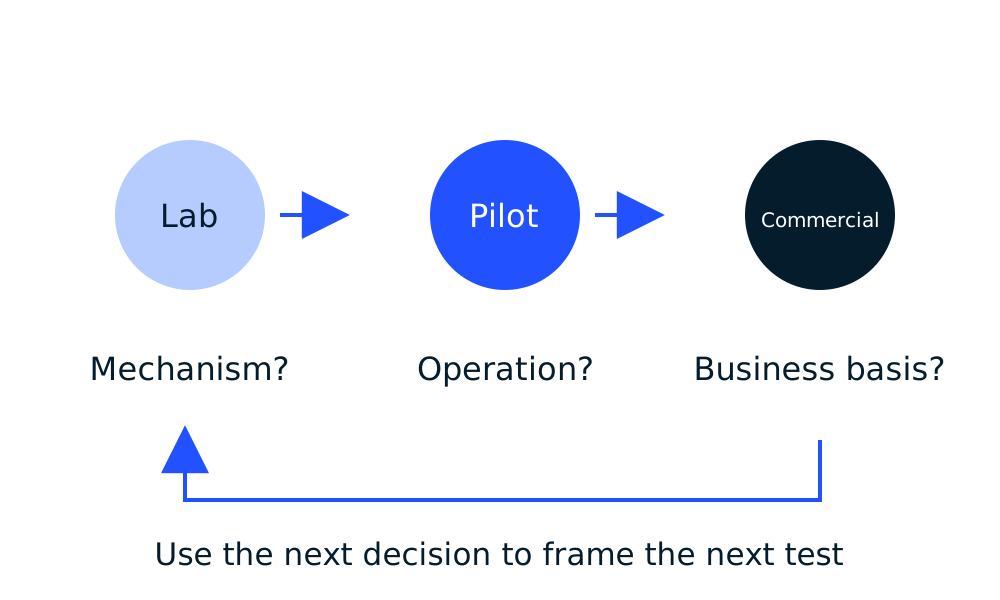 Open figure at full size (opens in a new tab)
Examine the pilot and economic basis together
A pilot campaign can examine behavior that affects the proposed design and its cost basis. Pressure drop, heat removal, flow distribution and catalyst life may influence equipment requirements or operating assumptions. The pilot objective should explain which of these relationships is being investigated. This makes the results easier to use in a subsequent design comparison and avoids collecting data without a clear connection to the investment question.
The economic view can then be updated with the supported findings and the uncertainties that remain. Consider how operating severity, safety requirements and performance expectations relate to the proposed option. Where further development is needed, explain which assumption drives that need and what evidence would resolve it. The outcome is a clearer basis for the next commitment, not a prediction that every promising laboratory candidate will become a viable commercial process.
Connect the evidence before committing further
The preferred catalyst or process option is shaped by economics, operating severity and safety as well as performance. A technically impressive target can lose its appeal if achieving it requires unacceptable cost or difficult operating conditions. Considering these relationships early helps the team understand what a useful improvement would look like.
Bring the laboratory evidence, process constraints and economic assumptions into one discussion. Which target is necessary? Which condition drives the design? What information would change the view? The next development step can then address a specific uncertainty, with a clearer reason for the work and a basis for reviewing its results.
Different scales answer different questions
| Study setting | Question to examine | Evidence to connect |
|---|---|---|
| Laboratory | What can the material or candidate do under the tested conditions? | Properties, test conditions and measured performance |
| Pilot | Which larger-scale behavior must the study represent? | Flow, heat and mass transfer, catalyst life and operating requirements |
| Proposed process | Does the option fit the wider requirements? | Engineering constraints, safety questions and economic assumptions |