
Small Modular Reactors: Expectations, Reality and Their Role in Decarbonization
Smaller nuclear plants promise flexibility and simpler construction. Their climate value depends on cost, credible delivery and where their energy is needed.
The short version
- A smaller reactor may be easier to finance, but cheaper electricity must be demonstrated.
- Repeated production can create savings when designs, suppliers and committed orders support it.
- Climate value depends on energy needs, whole-system alternatives and credible delivery.
Smaller reactors, different economics
Small modular reactors, or SMRs, bring a familiar technology into a different package. They use nuclear fission to produce heat, which can generate electricity or serve other energy needs. An SMR generally produces up to 300 megawatts of electricity per module, compared with the much larger output of a conventional nuclear reactor.
The attraction is understandable: build smaller units, manufacture more components in factories and expand when demand grows. Yet a smaller reactor does not automatically mean cheaper electricity, faster delivery or fewer environmental challenges. The useful question is where this approach can deliver measurable benefits.
A smaller unit can reduce the amount of money committed to a single reactor. That may suit a utility whose grid or budget cannot accommodate a large plant. Several modules could also be added in stages rather than funded together.
But the price of one reactor and the cost of its electricity are different measures. A smaller plant spreads some expenses, including security, staff and licensing, across less output. Several modules may share facilities, but those savings depend on the design and operating rules.
Financing matters too. Interest builds while a project is under construction, before electricity earns revenue. A shorter construction period could reduce that burden; a delay could increase it. To judge an SMR proposal, compare its complete project cost, financing terms and expected electricity production, rather than the size of its modules alone.
What must happen for modular production to pay off
- 01A stable design
Standardize and license a design that can be repeated.
- 02Committed orders
Secure enough demand to justify production facilities.
- 03Repeatable delivery
Coordinate manufacturing, transport and site construction.
- 04Measured results
Use completed projects to test cost and schedule savings.
Factory production needs a repeatable business
SMRs aim to shift more work into factories, where repeated tasks can improve quality and productivity. The commercial hope is that a series of similar reactors will become easier and less expensive to build.
That outcome requires a stable design, capable suppliers and enough committed orders to keep production moving. The first project also carries work that later projects may reuse, including engineering, licensing and supply-chain development. Expected savings from future production are therefore different from costs already demonstrated.
The cancelled NuScale–UAMPS project illustrates this distinction. On 8 November 2023, the partners ended their planned US project after concluding that it was unlikely to secure enough customer subscriptions to remain viable. Higher projected costs formed part of its commercial context, but the cancellation cannot be reduced to one cause.
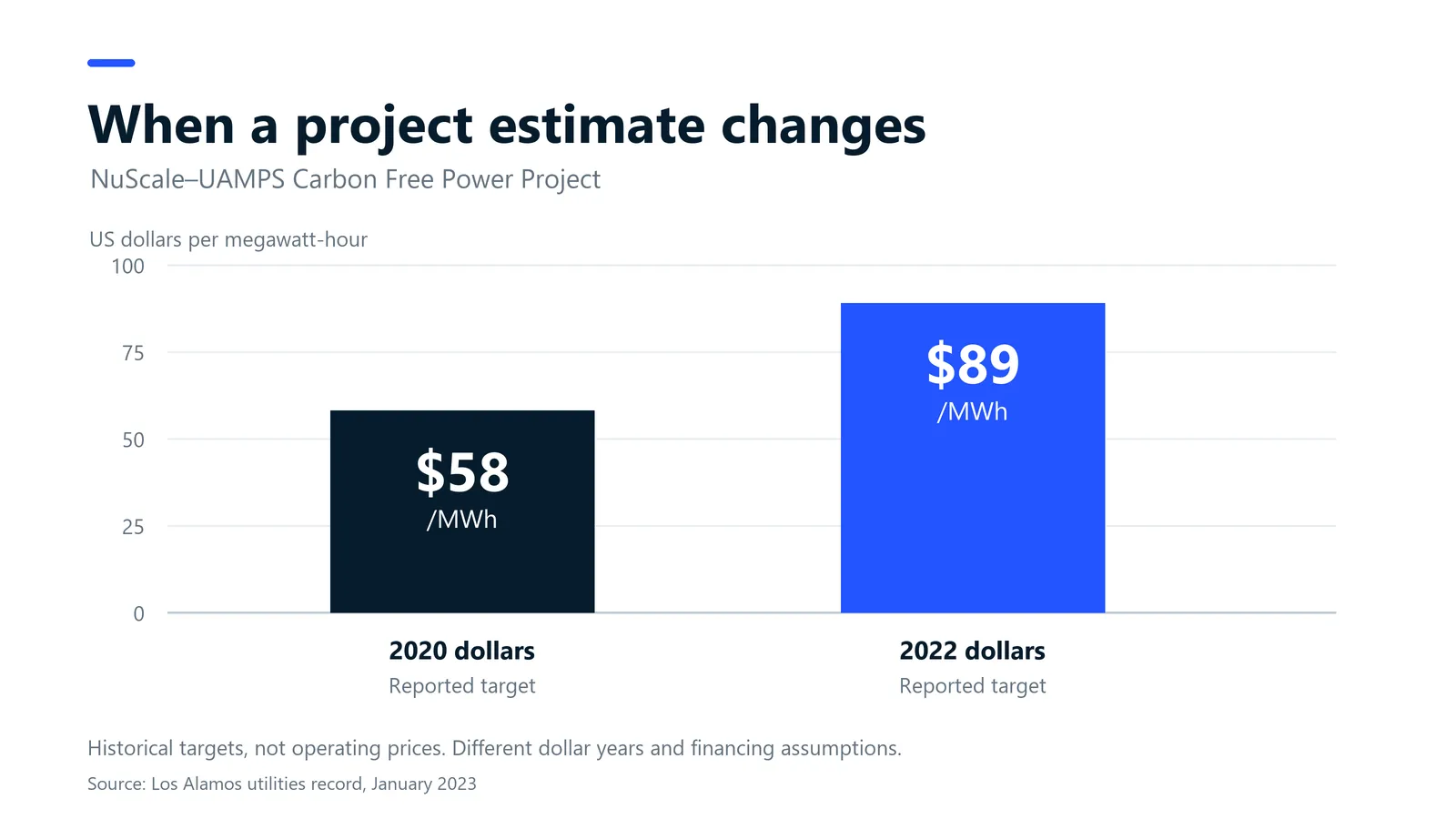
The earlier electricity target was $58 per megawatt-hour in 2020 dollars; the January 2023 target was $89 in 2022 dollars. These were project estimates, rather than operating prices. The different dollar years and financing assumptions matter, and the revised budget anticipated federal support. The figures reflect uncertainty in an early project, not a price forecast for all SMRs.
The lesson is practical: technical progress and regulatory approval do not, by themselves, establish a viable market. A project also needs customers willing to buy its output under workable terms.
Historical CFPP electricity targets
 Open figure at full size (opens in a new tab)
Capacity can grow in steps
One useful difference is the size of each capacity addition. A region may need more electricity without needing a large reactor's full output immediately. Smaller units could allow investment to follow demand more closely.
Consider an illustrative comparison: one 1,200-megawatt reactor and four 300-megawatt modules provide the same total installed capacity. The modular option divides that capacity into four additions: 300, 600, 900 and eventually 1,200 megawatts. It could also permit maintenance on one module while others operate, subject to the plant's design and operating arrangements. Equal capacity does not imply equal cost, annual electricity output or safety.
This flexibility has limits. Roads, cooling systems, grid connections and other shared facilities may need investment before the first module starts. A smaller unit still requires a suitable site, qualified workers and regulatory approval. Staging can change when capacity arrives; it does not remove the work needed to deliver it.
Safety and waste remain design questions
Some SMR designs use passive safety features, such as natural circulation or gravity, to perform particular cooling functions with less dependence on powered equipment. These features can offer advantages, but their effectiveness must be demonstrated for the relevant operating and accident conditions.
For sites with several modules, reviewers must also consider shared risks. A flood or a problem with common infrastructure could affect more than one unit. Independent assessment remains essential.
Smaller reactors still produce radioactive waste. Comparing waste per reactor can be misleading because the reactors produce different amounts of electricity. A fairer comparison considers waste per unit of energy, its characteristics and the requirements for storage and disposal. Fuel choice, efficiency and operating strategy all matter. A credible project needs a waste-management and decommissioning plan from the beginning.
SMR expectations and the evidence still needed
| Expectation | Reality to assess | Question to ask |
|---|---|---|
| Cheaper electricity | A smaller project can still have high costs per unit of output. | What changes after repeat builds? |
| Faster construction | Factories help only alongside licensing, site work and supply chains. | Is the full delivery schedule credible? |
| Greater safety | Passive features differ by design and require regulatory assessment. | Which risks have been demonstrated and reviewed? |
| Less waste | Waste per unit of electricity depends on fuel and reactor design. | Is long-term management funded? |
| Broad decarbonization | Useful applications depend on energy needs, timing and alternatives. | What service does this project provide? |
Where could SMRs help decarbonization?
Nuclear generation can provide low-carbon electricity without relying on sunshine or wind. SMRs could contribute this kind of supply in systems where their unit size and operating characteristics are useful. Like other plants, they still need maintenance and can experience outages.
Their value should be assessed alongside renewable generation, storage, transmission, energy efficiency and other available options. The relevant comparison includes the cost and reliability of meeting demand across the whole system, rather than comparing generation prices in isolation.
Industrial heat offers another potential application. Factories need heat as well as electricity, and some reactor designs may supply both. The fit depends on the temperature required, the distance to the customer and whether the process can accept the available heat reliably. Higher-temperature applications require suitable designs; the SMR label alone does not establish that capability.
Existing industrial or retired power-plant sites may offer useful infrastructure. Each location still needs assessment for cooling, grid access, safety and community acceptance. The strongest case starts with a specific energy need and tests whether an SMR can meet it competitively.
Watch delivery, not just announcements
The evidence that matters is concrete: realistic budgets, construction schedules, committed customers and sustained operating performance. Later projects should show whether standardization actually reduces costs and delays.
Other questions belong in the same assessment. Is the required fuel available? Who carries the financial risk if construction slips? Are waste management and eventual plant closure funded? Has the surrounding community been meaningfully involved?
SMRs deserve neither automatic confidence nor automatic dismissal. They offer a potentially useful way to deploy nuclear energy, with advantages that depend on project conditions. Their contribution to decarbonization will be established by plants that deliver useful energy safely, reliably and at a cost their customers can sustain.