
Industrial Heat Pumps: Even It is Hard to Implement, But Non-Negotiable.
Industrial heat pumps can move available heat to a more useful temperature. Their potential depends on the temperature gap, the process demand and how the system fits the site’s energy and operating conditions.
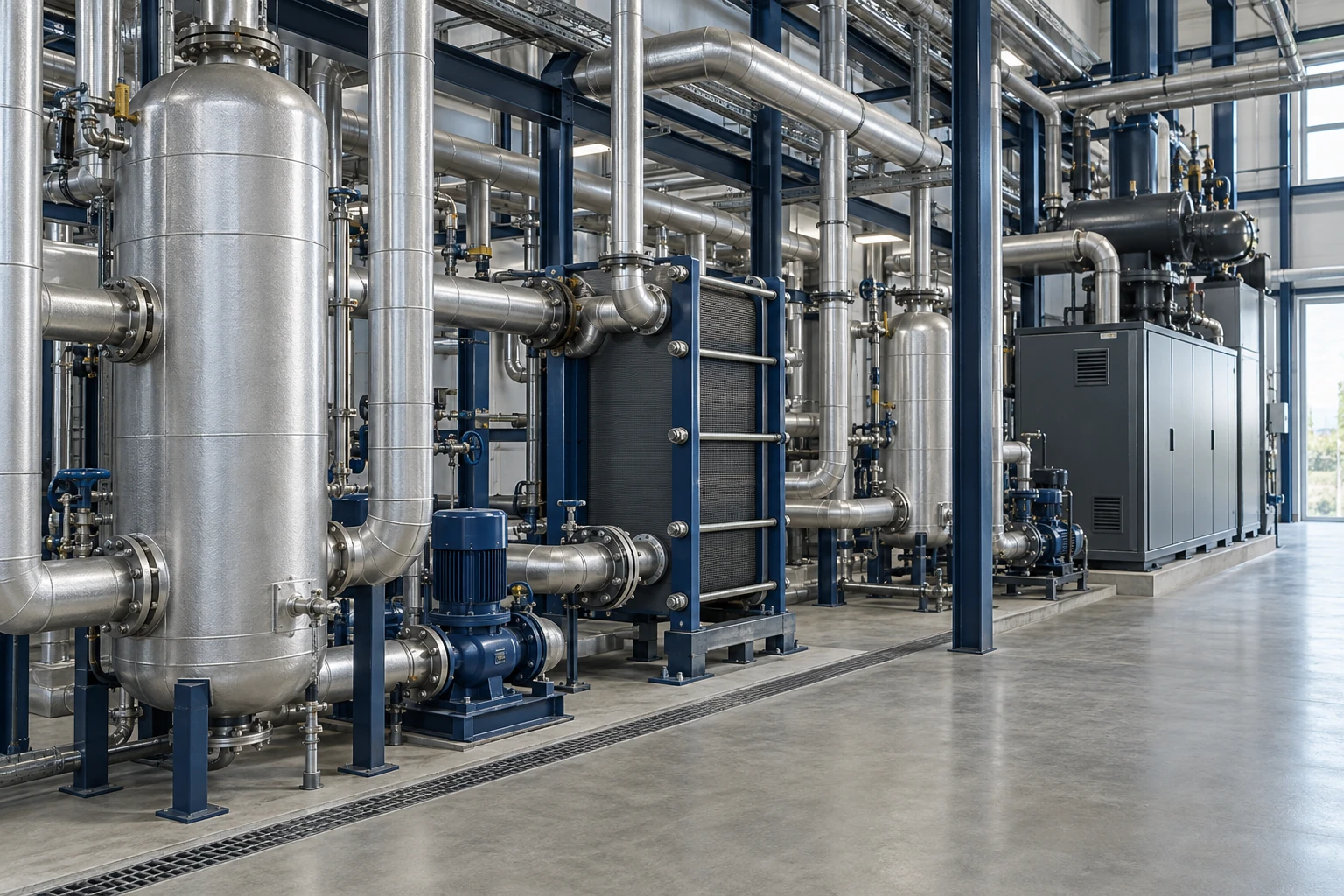
The short version
- Match a suitable heat source with a real and sufficiently aligned demand.
- Temperature lift, electricity supply and integration influence performance and economics.
- Assess technology maturity, refrigerants, capital and operating constraints for the application.
Move heat rather than create all of it
A heat pump uses work, usually electricity, to transfer heat from a lower-temperature source to a higher-temperature destination. Industrial applications may use available waste heat to serve a process, district-heating or other heating demand.
Heating coefficient of performance, or COP, compares useful heat delivered with work input. Because transferred heat contributes to the output, COP can exceed one without violating energy conservation. Actual performance depends on temperatures, equipment and operating conditions; a fixed value cannot be assumed.
Understand the heat balance before the performance claim
A heat pump uses work to move heat from a lower-temperature source to a higher-temperature destination. The delivered heat combines the energy taken from the source with the work supplied to the system. This is why its useful heat output can exceed its electricity input without creating energy. Coefficient of performance, or COP, describes that ratio under specified conditions. It is different from describing the fraction of heat converted into work by a heat engine.
A quoted COP is most useful when the operating conditions and boundary are clear. The temperatures, available source, required output and supporting equipment all matter. A simple heat-flow illustration can explain the mechanism without presenting a universal COP or a guaranteed saving. The practical assessment can then compare useful heat delivered, electricity required and the additional site demands under the proposed operating pattern, including conditions away from an ideal design point.
Move heat to a useful temperature
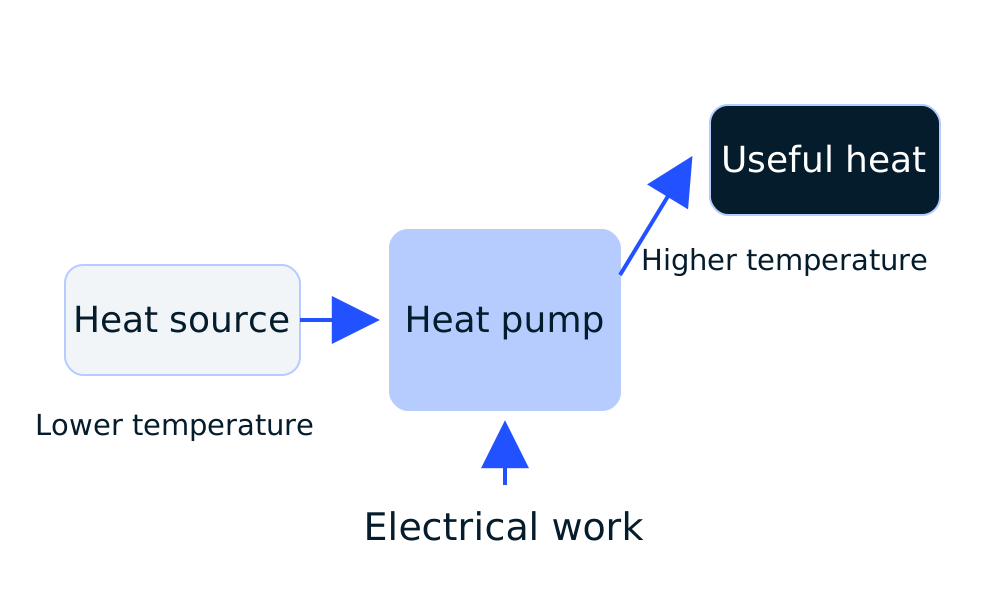 Open figure at full size (opens in a new tab)
Find a suitable source and sink
Define the heat source’s temperature, quantity and availability, together with the demand’s required temperature and operating schedule. The temperature lift between them matters to the work required. Consider fluctuations, shutdowns and whether heat supply and demand coincide.
Heat pumps do not address every industrial temperature requirement. The maturity and availability of a particular system depend on its temperature range, working fluid and duty. Review supplier evidence for the intended application rather than applying one readiness label to all industrial heat pumps.
Match a heat source with an actual process demand
Waste heat is useful when its quantity, temperature and timing can be matched with a destination. A source may be available only during part of production, while the heating demand has another schedule. The distance between them and the condition of the heat stream can affect integration. A review can describe those features before selecting a device, because an attractive heat source on a diagram does not establish a continuous useful supply at the required location.
For an illustrative opportunity, a site could compare heat recovered from one process with a nearby heating requirement. It would examine the operating overlap, the temperature lift and any existing heat-recovery arrangement. The intention is to identify a plausible match and the information needed to examine it. It is not to assume that every low-temperature stream is suitable or that a heat pump can provide every industrial temperature requirement.
Five checks for a heat-pump opportunity
| Check | Information to examine |
|---|---|
| Heat match | Source and demand temperatures, quantities and availability. |
| Technology fit | Temperature lift, working fluid, duty and relevant operating evidence. |
| Site integration | Utilities, controls, layout, maintenance and safety requirements. |
| Economics | Capital, electricity, peak charges, finance and the comparison heat route. |
| Emissions | Electricity supply, displaced fuel, lifecycle boundary and refrigerant management. |
Evaluate the site integration
Retrofitting can require changes to heat exchangers, utilities, controls and operating arrangements. Refrigerant properties, leakage management and applicable safety requirements belong in the assessment. Maintenance capability and equipment access also influence practicality.
Electricity prices, peak-demand charges and reliability affect operating cost. Compare capital, financing and operating cost with the existing heat route on a consistent basis. Incentives or policy support may influence the comparison, but availability depends on the place and time.
Review technology readiness and site interfaces together
Technology readiness depends on the particular application, temperature range and operating conditions. Experience in one heating task does not establish the same readiness for a different process. The review can distinguish available equipment with relevant references from an application requiring further development. It can also consider controls, electrical capacity, maintenance access and the relationship with the existing heating system. These interfaces influence whether a proposed installation can provide the intended service.
Refrigerant choice and its environmental characteristics are another part of that discussion, along with equipment suitability and the management arrangements required at the site. A temperature-readiness comparison can help identify the relevant application questions, while a particular technology's status needs current evidence. Information from suppliers and a site-specific engineering study can then help clarify the current application boundary and remaining uncertainties.
Heat-pump maturity varies with temperature
| Temperature band | Maturity described | Example applications |
|---|---|---|
| Below 80 °C | Established market | Paper: de-inking. Food: concentration. Chemicals: bioreactions. |
| 80–100 °C | Commercial and competitive; large-scale deployment still developing | Paper: bleaching. Food: pasteurisation. Chemicals: boiling. |
| 100–140 °C | First commercial applications in relevant environments | Paper: drying. Food: evaporation. Chemicals: concentration. |
| 140–160 °C | Pre-commercial demonstration | Paper: pulp boiling. Food: drying. Chemicals: distillation. Various industries: steam production. |
| 160–200 °C | First commercial applications for small-scale MVR systems and heat transformers; early-to-large prototypes also listed for this band | Various industries: high-temperature steam production. |
| Above 200 °C | Early prototype | Various industries: high-temperature processes. |
Connect performance with the emissions case
A heat pump can support electrification and useful heat recovery when the conditions fit. The emissions outcome depends on the electricity supply and the fuel or heat source being displaced, alongside equipment and refrigerant considerations.
Different temperature duties and market contexts provide reasons to investigate options. They do not establish a universal saving or preferred supplier. A practical feasibility study joins a measured heat balance with a site-specific technical, cost and emissions comparison.
Separate market interest from the site investment case
The investment question includes equipment, integration and the cost of providing the required electricity. Operating-hour patterns and peak demand can influence that comparison. Emissions also depend on the electricity supplied and the heat source being displaced. These relationships make it useful to examine energy, emissions and cost together under a consistent boundary. An apparently favorable equipment performance does not settle the full site result.
The original discussion describes market growth and support arrangements as reasons for interest in industrial heat pumps. Historical market shares, forecasts and incentives are not fixed conditions for a new project. A current assessment can check relevant support separately and explain any dependence on it. Heat pumps can be considered alongside heat recovery and other process changes, with the decision based on the actual heat service and supporting evidence rather than a universal obligation to adopt a particular technology.