
The Laws of Thermodynamics: Make Sure You Understand How It impacts to Decarbonization.
Energy quantity, energy quality and chemical conversion are related questions. Understanding their limits helps compare decarbonization pathways and identify useful improvements without expecting one innovation to remove every constraint.

The short version
- Account for where energy enters, leaves and loses its ability to perform useful work.
- Separate reaction feasibility and equilibrium from reaction rate.
- Evaluate capture, transport, storage and heat recovery as a connected system.
Energy is conserved, but its usefulness changes
The first law of thermodynamics describes energy conservation. A balance tracks energy entering, leaving or accumulating, including useful output and heat exchanged with the surroundings. Energy changes form rather than disappearing.
The second law limits what those transformations can achieve. Real processes introduce irreversibility: some capacity to perform useful work is degraded. Exergy measures that capacity relative to the environment. It helps explain why equal quantities of electricity, high-temperature heat and low-temperature heat cannot always provide the same service.
Distinguish energy balance from useful energy
Begin with the service required: electricity, heating, cooling or a chemical transformation. Then examine the form and quality of energy available. A warm stream may suit direct heating even when its potential for generating electricity is limited.
Energy and exergy balances answer complementary questions. The first checks the quantities; the second helps locate avoidable degradation. Neither alone proves that a modification is worthwhile. Equipment, operating schedules, integration costs and a useful destination for the recovered energy also matter.
Use physical limits as a comparison basis
For a heat engine between specified hot and cold reservoirs, the Carnot expression gives an ideal reversible limit. Temperatures must be absolute, in kelvin. Actual equipment performs below that limit because of practical irreversibilities. A calculation with assumed temperatures is a benchmark, not a turbine rating.
Rankine and Brayton cycles describe other power-system arrangements. Their performance still requires appropriate operating conditions and losses. Heat pumps, by contrast, use work to transfer heat; their coefficient of performance measures a different service. Choose the right boundary and measure before comparing technologies.
A heat-engine comparison limit
- T_cold
- Cold-reservoir absolute temperature, in kelvin
- T_hot
- Hot-reservoir absolute temperature, in kelvin
Distinguish chemistry from reaction speed
Gibbs free-energy change helps describe reaction favorability and equilibrium under stated conditions. Reaction rate depends on activation barriers and the available pathways. A favorable equilibrium does not imply a fast reaction.
Catalysts can improve rate and selectivity without changing the equilibrium position or overall free-energy difference for the same reaction and conditions. An unfavorable reaction may be driven by suitable inputs or coupling. A positive free-energy change is not the same as an endothermic heat requirement; Gibbs energy and enthalpy describe different quantities.
Evaluate conversion chemistry and its supporting inputs
Carbon dioxide is chemically stable. Assess its conversion through the complete reaction, including energy inputs and co-reactants. Routes retaining carbon’s oxidation state differ from routes reducing it into products such as methanol or methane.
When hydrogen is needed, include its production alongside capture, conversion, separation and product use. A promising catalyst or reactor does not by itself establish a carbon benefit or commercial feasibility. Compare the full material and energy requirements with the alternative way of providing the same product or service.
Read the chemical energy reference carefully
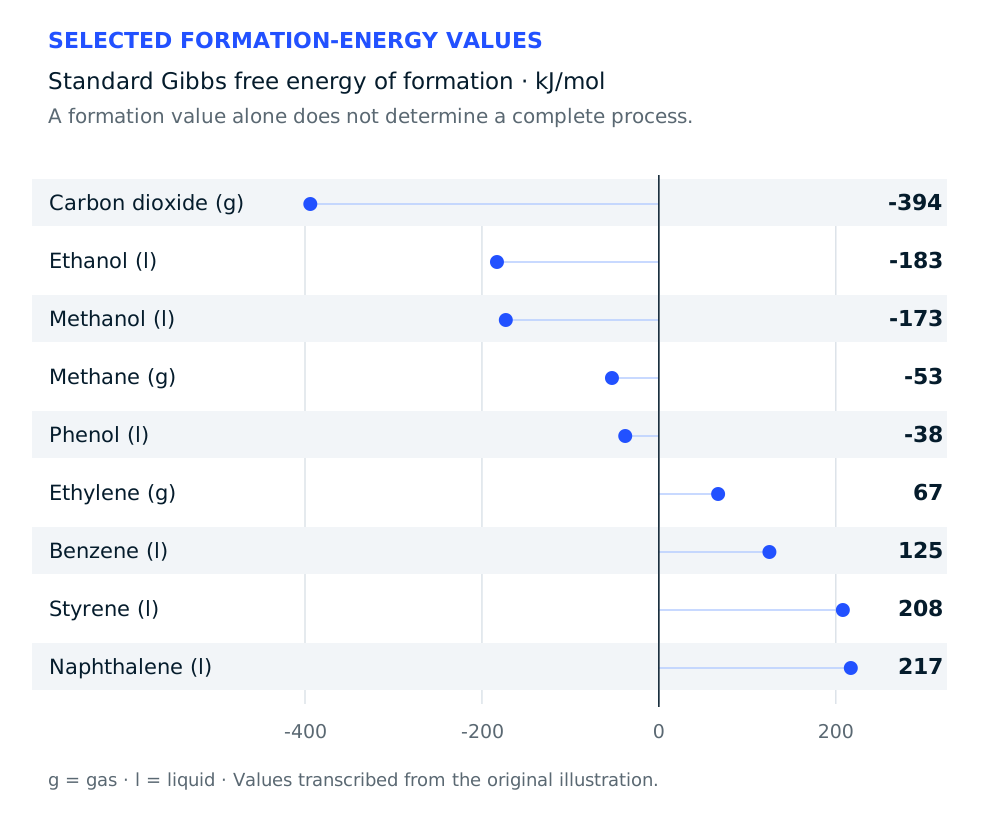 Open figure at full size (opens in a new tab)
Read figure data
| Selected original label | kJ/mol |
|---|---|
| Carbon dioxide (g) | -394 |
| Ethanol (l) | -183 |
| Methanol (l) | -173 |
| Methane (g) | -53 |
| Phenol (l) | -38 |
| Ethylene (g) | 67 |
| Benzene (l) | 125 |
| Styrene (l) | 208 |
| Naphthalene (l) | 217 |
Follow the complete carbon-management chain
Capture can require heat or electricity for separation and regeneration. Compression, cooling or liquefaction prepare carbon dioxide for transport. Purity and impurities affect equipment and phase behavior. Injection and monitoring add further requirements.
The energy penalty is the additional input or reduced useful output associated with capture. Heat integration may help, but retrofit constraints differ from a purpose-designed installation. Pipeline and shipping choices depend on volume, distance, terrain and access.
Geological storage requires assessment of capacity, permeability, injectivity and containment. Compare energy, costs and emissions across the complete chain, including infrastructure, leakage prevention and long-term monitoring.
Compare recovery and carbon management at system level
Heat recovery may reuse energy directly, convert it into work or upgrade its temperature. Match the source’s temperature, quantity and availability with an actual demand. Consider distance, operating overlap, equipment and losses; total heat leaving a process is not the same as practically recoverable heat.
The options below illustrate different mechanisms and trade-offs. Use them to identify study questions, then evaluate the proposed duty. A consistent system boundary connects physical limits with useful output, integration requirements and the next investment decision.
Match the recovery method to the available energy
| Technology | Heat category | How it can help | Main trade-off |
|---|---|---|---|
| Regenerative burners | High | Store exhaust heat to preheat combustion air; reduce fuel demand. | Complex controls and high initial cost. |
| Recuperative burners | High | Use heat exchangers to preheat incoming air or gas; simpler than regenerative burners. | Lower efficiency than regenerative burners; furnace modifications needed. |
| Economizers | Low–medium | Recover boiler flue-gas heat to preheat feedwater and reduce fuel use. | Acidic condensation can require resistant materials and increase cost. |
| Waste-heat boilers | Medium–high | Use process waste heat to generate steam, potentially at high pressure. | Variable heat supply may require auxiliary firing to maintain steam output. |
| Recuperators | Low–high | Transfer hot-gas heat to incoming air or gas across industrial processes. | High heat-transfer performance can require more complex designs. |
| Regenerators | Medium–high | Store heat from hot gas for incoming gas; useful for cyclic operation. | Can be large, with high capital cost. |
| Rotary regenerators | Low–medium | Rotate a heat-storage medium for continuous, efficient heat recovery. | Precise control and leakage management. |
| Run-around coil systems | Medium–high | Circulate fluid between heat exchangers; flexible recovery from multiple sources. | Pumping energy and lower recovery efficiency. |
| Heat-recovery steam generators | High | Recover gas-turbine exhaust heat to produce steam, potentially at high pressure. | Complex design and high capital cost. |
| Plate heat exchangers | Medium–high | Corrugated plates provide compact, effective heat transfer. | Clean fluids needed; fouling can impair performance. |
| Heat-pipe systems | Medium–high | Phase change and capillary action transfer heat without moving parts; potentially low running costs. | Working-fluid properties limit the usable duty. |
| Thermoelectric generation | Medium–high | Convert a temperature difference directly into electricity without moving parts. | Low conversion efficiency; often suited to smaller applications. |
| Thermionic generation | High | Convert heat into electricity through electron emission without moving parts. | Very high temperatures and low conversion efficiency. |
| Thermophotovoltaic generation | Low–high | Convert thermal radiation, including infrared, into electricity using photovoltaic cells. | Temperature limits, possible efficiency loss at higher temperatures and cost. |
| Heat pumps | Low–medium | Upgrade heat through a refrigeration cycle; can support heating and cooling. | Electricity demand and performance sensitivity to temperature lift. |
| Direct-contact condensation recovery | Medium–high | Condense steam directly against a cooling medium; simple, high heat-transfer rates. | Fluid mixing introduces contamination risk; clean condensate is needed. |
| Indirect-contact condensation recovery | Medium–high | Condense steam across a heat-exchanger surface to keep the cooling medium separate. | Lower transfer rates than direct contact. |
| Transport membrane condensers | Medium–high | Recover water vapor and heat through a membrane, including from humid gas. | Membrane performance and fouling. |
| Piezoelectric harvesting | Not a thermal category | Convert vibration or mechanical stress into electricity, including industrial vibration. | Low output; depends on an available vibration source. |