
Ensuring isothermality is important in lab and pilot-scale tests.
A temperature difference inside a small test reactor can change what a catalyst appears to do. Understanding that difference helps separate catalyst behavior from the behavior of the experiment.

The short version
- Temperature can influence reaction rate, conversion and product selectivity.
- Check variation along and across the bed, alongside particle-scale effects.
- Evaluate possible test changes against flow, pressure drop, measurement and safety constraints.
Begin with the measurement objective
Catalyst tests often provide data for larger reactor designs. For kinetic studies or catalyst comparisons, temperature variation can make a measured change partly reflect the test environment.
Isothermal testing seeks approximately uniform temperature in the relevant region. One instrument reading does not establish uniformity throughout the reacting material.
Relate the temperature observation to the reacting material
A reported temperature needs a location and a meaning. It may describe a controlled boundary, an inlet condition or a measurement within the equipment. Those observations are not automatically interchangeable with the temperature experienced throughout the catalyst bed. Explaining where and when a value was obtained helps readers understand which part of the reacting system it represents and which part remains an assumption.
A study can therefore describe the intended temperature basis and the observations used to support it. If the analysis assumes a uniform condition, state the evidence for that assumption over the conditions examined. This makes temperature consistency an interpretable part of the result, rather than an equipment setting that appears beside the conversion or selectivity value without explaining its relevance.
The required consistency follows from the purpose and accuracy of the study. If temperature-sensitive behavior is being compared, explain which observations support treating the conditions as comparable and which variations could matter to the interpretation. Where the present evidence is limited, that limitation can guide the next measurement. This keeps the assessment connected to a meaningful experimental question rather than a generic statement that a temperature target was maintained.
Look along, across and within the bed
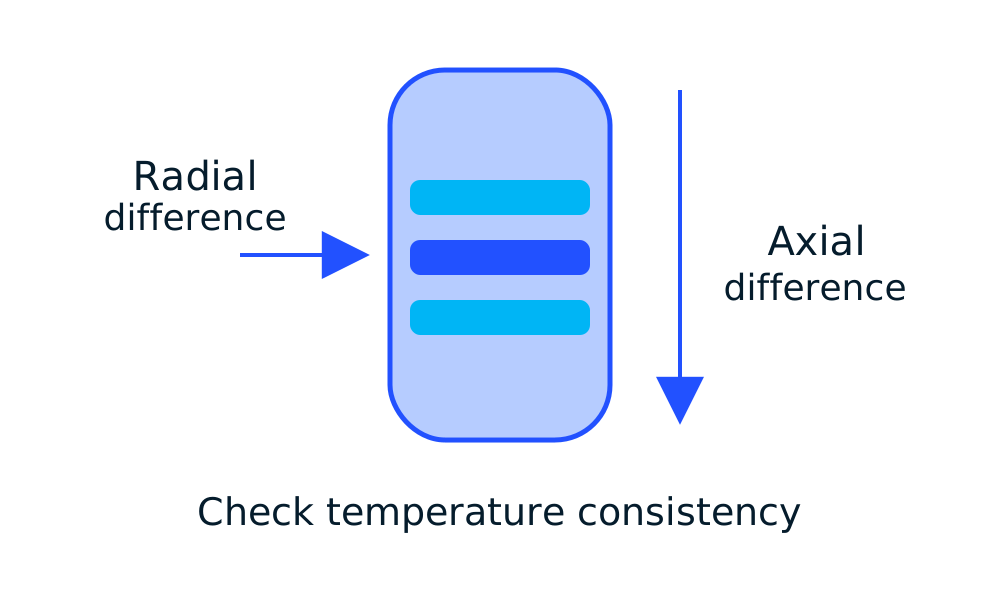
Axial gradients run along the reactor; radial gradients run across it. Heat transport through the fluid, bed and reactor boundary can differ from conduction inside an individual catalyst particle. At low laboratory throughput, limited convective heat transport can make bed-scale variation relevant.
Their relative importance depends on the reaction and equipment. Check whether measurement locations represent the reacting material.
Check where temperature differences may occur
 Open figure at full size (opens in a new tab)
Look at temperature together with the operating history
The test history gives a spatial temperature description further context. Changes in feed, flow or operating conditions can affect the period during which observations are compared. A useful record explains the sequence and the basis used to decide that the selected data represent the condition of interest. This supports comparison between runs without assuming that every reading describes the same reacting state.
Consider two runs with the same stated operating target. The comparison would ask whether the observations were taken at comparable locations and periods, and whether relevant conditions differed. These questions help distinguish a common setting from a common reacting condition. They also show why measurement context belongs alongside the result when a team discusses the reliability and comparability of a temperature-sensitive test.
Treat possible adjustments as coupled choices
Possible approaches to examine include lower conversion, bed geometry, inert dilution, particle size, voidage, material conductivity, co-feed properties and flow. Each affects more than temperature alone.
For example, smaller particles can change pressure drop, while more flow can change residence time and conversion. Inert dilution can improve heat distribution but can also alter contacting. The options below therefore describe review questions, rather than prescribed settings.
Give each proposed adjustment an evidence question
The possible adjustments in the table address different parts of the thermal and flow arrangement. Their suitability depends on the experiment, material and reaction. An adjustment should therefore have a clear question: which influence is it intended to examine, and what observation would show whether that influence has become clearer? This approach keeps the study focused on interpretation rather than assuming that every listed measure should be applied together.
A change in particle or bed arrangement may also alter contacting or pressure drop; a change in flow may alter the comparison basis. Record those connected effects as questions for the review. The chosen study can then describe what was held comparable, what changed and what remains uncertain. This makes an apparent improvement in temperature consistency easier to interpret within the complete experimental objective.
Eight coupled test considerations
| Possible lever | What else needs examination |
|---|---|
| Conversion level | Can heat release or uptake be reduced without losing the measurement objective? |
| Bed and particle geometry | Does the length/particle relationship affect contacting and temperature representation? |
| Inert dilution | Is mixing uniform, and how does dilution change flow and conversion? |
| Particle size | How do heat transport, diffusion and pressure drop change together? |
| Bed voidage | What changes in contacting, flow resistance and heat transport? |
| Support conductivity | Is a conductive material compatible with the catalyst chemistry? |
| Co-feed properties | Is the co-feed compatible, and does it change chemistry or transport? |
| Flow rate | How are residence time, conversion, pressure drop and heat transfer affected? |
Make the interpretation traceable
Record the test configuration, temperature observations and the reason a particular adjustment was selected. Where practical, comparison runs can examine whether the inferred catalyst behavior changes when the relevant transport condition changes.
The result can then state its evidence and limitations before extrapolation.
Compare temperatures at the appropriate scale
A bed-level temperature description and a particle-level temperature description answer different questions. The first concerns variation through the equipment; the second concerns the material where the reaction occurs. Keeping those scales visible helps readers follow the interpretation. A measurement that informs one question may still leave another unresolved, particularly when the flow and material properties make different transport effects relevant.
A useful conditional comparison could examine two proposed changes with different mechanisms. Increasing flow may change heat transfer and also change residence time or pressure behavior; changing a support or diluent may change the thermal behavior and the bed arrangement. Even when both are intended to improve temperature consistency, their test implications can differ. Explain which effect each change is meant to address, what else it changes and what observation would distinguish their influence. This connects the available levers with the reaction and contacting questions rather than treating a similar temperature reading as proof that the tests are equivalent.