
The value of sharing Near Misses and Learning from Accidents
An anonymous petrochemical plant case explores how easier reporting, action follow-up and shared lessons can strengthen the way people learn from risk.

The short version
- A supportive reporting culture can help people share concerns.
- Clear ownership and follow-up help a finding lead to a response.
- Lessons can inform training and everyday work.
Notice the signals before they become routine
This anonymous petrochemical plant case explores learning from near misses. Equipment problems and unexpected releases were sometimes treated as routine because they had not caused serious harm. That view limited the information available for preventing future incidents.
A previously reported pressure problem became particularly relevant after a later accident. The lesson is the importance of connecting early signals with a response. A report has value when the organization examines what it may reveal about a recurring condition, rather than judging it only by the immediate outcome.
Distinguish the outcome from the potential consequence
A near miss is informative because the observed outcome does not describe everything that could have happened. A small release, an unexpected pressure movement or an equipment problem may have ended without injury, while still revealing a condition worth examining. The investigation can consider what interrupted the sequence, who or what could have been exposed, and whether that interruption would be dependable on another occasion. This gives the review a more useful basis than the absence of harm alone.
In the plant narrative, pressure-related events connected one unit's experience with a later accident elsewhere. A practical discussion could compare the circumstances rather than assume the events were identical. Were the operating mode, equipment condition and warning signals similar? Did an earlier action reach the people responsible for the later situation? Such questions make the lesson specific enough to discuss while avoiding the conclusion that every minor event predicts a major accident.
Make it easier for people to share what they see
A simpler reporting process used digital forms and on-site kiosks. Employees were told about the purpose of reporting: the focus was on improving safety and understanding problems. Practical access and the surrounding culture were addressed together.
That combination connects the story with a wider people question. A reporting channel can exist while people still hesitate to use it. How a concern is received, whether the process is understandable and whether people expect constructive follow-up all influence the information that reaches the organization.
Make reporting useful for the person at work
Reporting arrangements benefit from being designed around the conditions in which people notice problems. A person may be working a shift, moving between tasks or unsure whether an observation is significant. A short form can capture what happened, where it occurred, what was different and any immediate response. The purpose is to preserve an understandable observation for review; the person reporting it does not need to solve the cause before contributing information.
The case used digital forms and kiosks, but the underlying idea is access and confidence. A team could examine whether its reporting channel is available at the point of work, whether examples make the reporting threshold clear, and how a supervisor responds to an uncertain concern. Listening respectfully supports useful information. It also remains important to follow the site's existing arrangements for urgent hazards, because an ordinary reporting form is not an emergency-response channel.
Connect each report with visible follow-up
Incident analysis helped identify systemic issues, and corrective actions were assigned and monitored. This created a connection between the initial report, an examination of its causes and the work needed to respond. Repeated issues could then be considered together.
The organizational lesson is a clear learning loop. Who receives the concern? Who is responsible for reviewing it? How is an action followed through? How do the people involved hear what happened? These questions make it possible to discuss whether reporting leads to a response that is visible and understood.
Separate an action recorded from an action understood
An action list can show that a concern has an owner without showing whether the underlying condition has been addressed. Review can connect each action to the issue it is intended to change, the information needed to judge completion and the people affected. If a recurring pressure concern leads to a maintenance or monitoring proposal, the relevant team can document its basis and the circumstances in which further review would be appropriate.
Follow-up is also a communication task. The person who raised the concern may need to know that it was received, how it was reviewed and what remains open. Other shifts may need the same information in a form that fits their work. A clear update can acknowledge an unresolved question without promising a result. This helps distinguish constructive feedback from a simple closure notice and gives the organization a better opportunity to learn from incomplete information.
From a report to shared learning
 Open figure at full size↗ (opens in a new tab)
Bring the learning back into everyday work
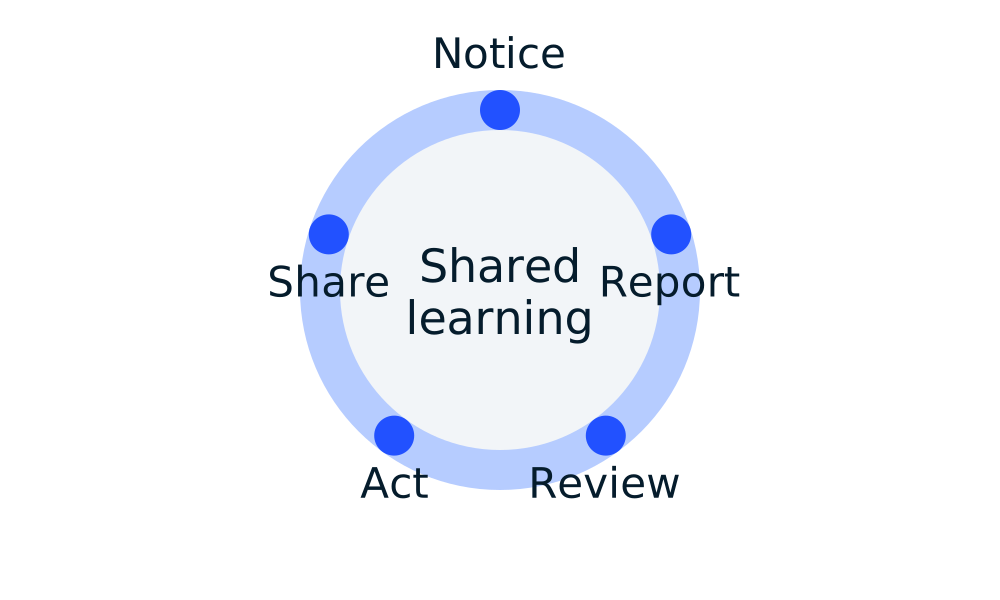
The case describes sharing lessons through meetings, newsletters and digital platforms, while training was updated with examples from reported incidents. Reviewing patterns also supported changes to safety practices. Learning was treated as continuing work rather than a document completed after an individual event.
For readers, the useful discussion is how information moves from one team or incident into other relevant work. Which lesson deserves a wider conversation? Where should a procedure or training example be reviewed? The case offers a way to examine that connection between reporting, response and shared learning.
Interpret trends with care
A rise in reporting can have more than one explanation. It may reflect easier access, greater confidence, a clearer definition of a near miss, or a change in the conditions people encounter. The report total is therefore a starting point for discussion, not a complete measure of safety. Looking at recurring themes, review quality, outstanding actions and whether lessons reach relevant teams can add useful context to the number of reports received.
The narrative connects reporting with training, maintenance attention and regular communication. Its practical value is that connected sequence rather than a transferable performance percentage. A team can revisit examples during training, check whether a lesson applies to other equipment, and ask what has changed since the review. When circumstances differ, the response may also differ. Continuing that conversation keeps shared learning connected to actual work and supports the next review without implying that incidents can be eliminated by reporting alone.
qadasd
asdasd
asdasdasdasd
asdasdas
Continue the conversation.
Browse all articlesSmall Modular Reactors: Expectations, Reality and Their Role in Decarbonization
Smaller nuclear plants promise flexibility and simpler construction. Their climate value depends on cost, credible delivery and where their energy is needed.
Read the articleEffective Management of Change (MOC)
An anonymous refinery narrative shows how equipment, controls, operating conditions and people can be reviewed together through Management of Change.
Read the article