
Transition from Lab Testing to Pilot Scale.
Moving to a pilot is a chance to examine behavior that a laboratory test may not fully represent. The study becomes more useful when reaction, transport and measurement questions are connected.
The short version
- Identify which process questions need evidence beyond the laboratory.
- Distinguish reaction behavior from heat and mass-transfer effects.
- Choose experiments and models that make the remaining uncertainty clearer.
Explain why a pilot is needed
A laboratory test can establish useful evidence about a reaction or product, while a pilot can address additional questions about a larger process. These may include producing material for evaluation, examining recycle streams and impurities, or understanding catalyst deactivation and byproducts. The learning objective should explain why the proposed pilot adds information that the existing tests do not provide.
Process complexity and the cost of a commercial commitment make that distinction useful. Engineering analysis can connect the experimental findings with a mathematical representation of the process. The model and the pilot then support each other: analysis identifies questions to test, while the resulting evidence helps examine whether the model represents the behavior that matters for the next decision.
Choose the information the pilot must add
A pilot can produce several kinds of information, but those aims need to be distinguished. Product quantities for evaluation, evidence about recycle streams and impurities, longer observations of catalyst behavior and tests of integrated equipment are different learning tasks. The equipment and campaign that suit one task may not answer another well. Defining the missing information helps explain why the proposed pilot is the appropriate next step.
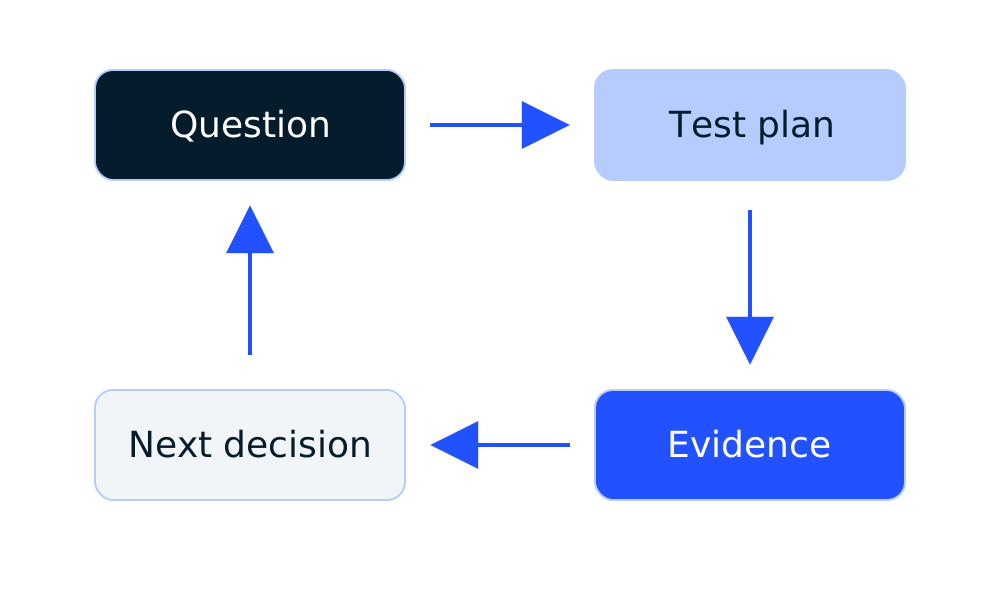
A useful planning question is what would change if the result differed from the present assumption. If product evaluation is the priority, sample quality and consistency deserve attention. If recycle behavior is uncertain, the relevant composition and accumulation patterns need examination. If stability matters, the duration and operating history become part of the evidence basis. This connects the pilot purpose with observations that can support the next engineering or commercial decision.
Connect a pilot with the next decision
 Open figure at full size (opens in a new tab)
Separate kinetics from transport effects
Reaction kinetics describes how reaction rates relate to conditions and composition. In a catalytic process, the observed rate may also be influenced by heat transfer or the movement of material to the catalyst. A change in measured performance between laboratory and pilot conditions may therefore have more than one explanation. Understanding those contributions is important before interpreting the result as a change in the catalyst itself.
A kinetic study needs experiments that can distinguish the intended reaction behavior from measurement errors and other influences. Concentration, partial pressure or activity may be relevant depending on the phase and process. Assumptions about steady conditions, equilibrium and the catalyst surface should be explicit. Their suitability needs to be considered for the tested range rather than assumed to support every scale or operating condition.
Make the measurement and model speak to the same question
A mathematical model expresses a view of the process through relationships and assumptions. An experiment supplies observations under particular conditions. The comparison is meaningful when the model describes those conditions and the measurements can examine the behavior of interest. A result from a different feed, catalyst form or operating history may still be useful, but the difference needs to be identified before it supports extrapolation.
For example, a study intended to understand reaction behavior can record how flow, temperature and particle characteristics were controlled or observed. If transport effects remain important, the analysis should account for them rather than attribute the entire result to kinetics. Systematic deviations and measurement limitations are part of that discussion. They help the team choose whether to refine the model, obtain different observations or examine a separate scale-dependent influence.
Consider the catalyst and the experimental arrangement
For a porous catalyst, material must reach the outer surface and may then move through pores before reacting. External transfer depends on the surrounding flow, while internal diffusion depends on the particle and its structure. Catalyst shape and size can influence the relationship between these effects. A study should examine which contribution the laboratory arrangement reveals and which may change in the pilot.
The reactor arrangement also influences what can be learned. Microreactors, for example, can provide a useful setting for questions involving residence time and heat or mass transfer, but introducing and preparing catalytic particles can be challenging. They are one possible research arrangement, not a universal replacement for the reactor or evidence required by a particular development program.
Explain what a representative pilot does and does not show
Representativeness concerns the phenomena that matter to the intended process. A smaller unit does not have to reproduce every commercial dimension to be useful, but it needs a clear explanation of which behaviors it examines. The study may focus on contacting, heat removal, catalyst life or the effect of a realistic feed. Its scope should make those choices visible to people who will later use the results.
The resulting report can separate demonstrated observations from extrapolated conclusions and questions still open. Describe the tested conditions, the comparison with laboratory evidence and the assumptions behind any larger-scale interpretation. If a behavior has not been represented, record the additional study or model evidence needed. This keeps the pilot valuable as a learning step while avoiding the impression that one campaign has established every aspect of future commercial performance.
Two different questions about the same result
| Lens | Question |
|---|---|
| Reaction behavior | What can the observation establish about the chemistry under the stated conditions? |
| Transport and operation | How might contacting, temperature, flow or the operating history affect the observation? |
Match the model to the process being studied
A gas–liquid–solid fixed-bed model may need to consider flow, dispersion and transfer between phases. A batch or semi-batch process may instead place emphasis on changing inventories, mixing and heating or cooling through the trial. Auxiliary operations, such as solvent removal, can also affect the relevant balance. The selected representation should follow the process question rather than the convenience of a familiar model.
Bring the model assumptions, experimental arrangement and data quality into the same review. This makes it easier to see what the pilot supports and what still requires further testing or analysis. The outcome is a clearer basis for the next scale-up decision, with reaction and transport effects considered together and the limits of the available evidence stated plainly.