
Why is Ideal flow pattern crucial for upscaling Fixed-bed reactor ?
A laboratory result is easier to interpret when the flow pattern behind it is understood. Back-mixing and bypass can affect how a test represents the intended fixed-bed reactor.
The short version
- Describe the flow assumption behind the test.
- Consider back-mixing and flow that bypasses the intended bed.
- Review bed geometry and the limits of the comparison before extrapolating.
Make the flow assumption visible
An ideal flow pattern is a useful reference for interpreting a reactor test. It helps describe how material is expected to move through the catalyst bed. The actual arrangement may differ, so the reference needs to be considered alongside the conditions and geometry of the experiment.
Ask whether the test represents the behavior being examined for a larger reactor. A clear comparison includes the flow assumption alongside the equipment and the measured result. This gives reviewers a more useful basis for discussing the observed catalyst performance.
Understand why the assumption matters to interpretation
A flow assumption connects the equipment with the calculation used to interpret its results. If the reacting material follows a different pattern from the one assumed, the measured conversion or product distribution may describe that combination of reaction and contacting. The issue is therefore not only whether a reactor appears to work. It is whether the analysis represents the conditions that produced the observed result.
Consider a comparison in which the catalyst and feed basis are unchanged but the bed arrangement differs. If the contacting history also changes, the results may not be interchangeable as evidence of intrinsic reaction behavior. A useful review identifies the difference and asks how it could influence the interpretation. It can then define a model comparison or further observation based on the documented conditions and the uncertainty that remains.
Make the flow idealization visible
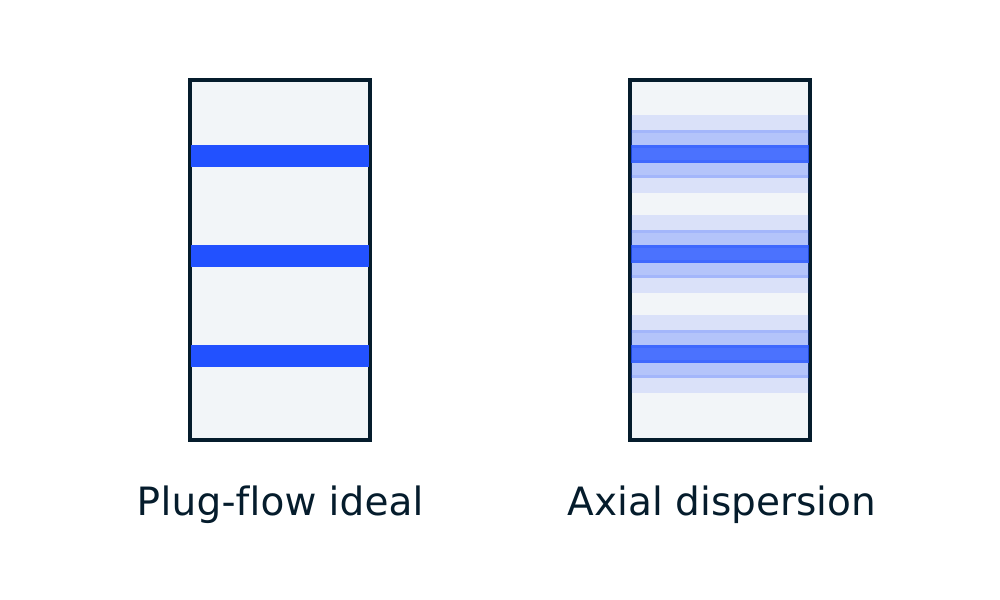 Open figure at full size (opens in a new tab)
Consider back-mixing and bypass
Back-mixing, also discussed as axial dispersion, concerns mixing along the direction of flow. Bypass concerns material taking a route that does not represent the intended passage through the bed. Both can influence the interpretation of a test and its relationship with an ideal flow pattern.
Their importance needs to be considered for the actual reaction and conditions. Flow behavior, reaction order, conversion and selectivity are related parts of that discussion. The aim is to understand which flow features may affect the comparison, rather than assume that one ideal description fits every experiment.
Keep the geometry ratio in context
The ratio of bed length to catalyst-particle diameter is a way to describe part of the geometry. It is not a complete description of the reactor, the flow or the reaction. A reported value becomes more informative when the particle form, bed arrangement, operating conditions and purpose of the analysis accompany it. Those details help explain why a geometry suitable for one study may deserve a different assessment in another.
The geometry ratio is considered alongside flow behavior, reaction order, conversion and selectivity. These relationships provide the context for examining whether a particular bed supports the intended flow approximation. A study can also ask whether the interpretation remains consistent when relevant conditions change. The conclusion needs evidence appropriate to the system, with the assumptions behind any chosen criterion made available for review.
Residence-time information offers another way to examine nonideal flow. A suitable tracer study follows how a nonreacting marker appears at the outlet over time; the resulting history can inform a flow model and questions about dispersion. Its interpretation depends on the test and boundary conditions. It describes the movement of material through the system and is considered alongside the reaction model when conversion is assessed. For a development review, the useful question is what the flow evidence establishes about the intended assumption. A qualitative diagram can show the distinction between an ideal path and spreading or bypassing, while the actual study supplies the observations needed for a system-specific interpretation.
The source’s lab/bench example
| Parameter | Lab-scale reactor | Bench-scale reactor |
|---|---|---|
| Catalyst content (g) | 3.8 | 24 |
| Catalyst particle size (mm) | 3 | 3 |
| Conversion | 0.77 | 0.83 |
| Required L/dₚ | 50 | 29 |
| Actual L/dₚ | 23 | 100 |
Review the bed and particle geometry
Bed length relative to catalyst particle diameter is one consideration discussed when assessing plug-flow behavior. It should be examined with the flow conditions and reaction characteristics. A general numerical threshold should not be assumed from the ratio alone; the comparison needs a basis relevant to the particular test.
Wall effects can also create a bypass concern. An experimental arrangement may therefore need a geometry review and the ability to accommodate changes. Bed dilution is another possible study option; its suitability and interpretation require examination for the particular test.
Distinguish the contacting paths
Bypass concerns material following a route that does not provide the intended contact with the catalyst bed. Axial mixing concerns how material spreads along the flow direction. These are different features of the contacting history. Considering them separately helps explain why an outlet result can depend on the flow arrangement as well as the reaction taking place, and why the model used to interpret that result needs an appropriate basis.
A practical record can then describe the wall-to-particle arrangement, loading basis, proposed reconfiguration or dilution, and the observations available for comparison. If one feature is changed, record the other conditions that also change with it. This gives the review a traceable basis for discussing a result and deciding what should be investigated next. It avoids treating a general recommendation about bed design as evidence that the actual flow has already been established.
Use the comparison to frame the next question
Document the assumed flow pattern, the bed arrangement and the observations used to assess them. This makes the basis of the result clearer to someone reviewing its possible use at another scale. It also identifies which differences need further explanation.
The useful outcome is a focused question for testing or analysis: which flow feature could alter the result, and what evidence would help assess it? That approach supports a clearer scale-up discussion without treating an ideal-flow assumption as a guarantee of representative performance.