
What’s Challenges in Scaling up or down of Single-phase Catalytic Fixed-bed Reactors ?
A catalyst tested at one scale can behave differently at another when flow, diffusion and temperature change. A useful study separates these influences before interpreting performance.

The short version
- Observed catalyst performance includes reaction and transport effects.
- Flow and heat-transfer differences can change the controlling mechanism.
- Connect test conditions with the intended reactor before extrapolating results.
Begin with the intended operating context
A commercial reactor and a research unit often have different purposes. A larger unit is considered in relation to production requirements and economics, while laboratory and pilot arrangements provide information about a catalyst or process. Smaller trials can support flexibility, easier changes and lower investment, but the resulting flow and heat-transfer conditions may differ from those being studied for a larger unit.
Start by describing the intended commercial conditions and the question the test must answer. Laboratory work may help establish a reaction scheme or kinetic behavior, while a pilot may explore conditions closer to the proposed process. Both are useful, but neither should be assumed to reproduce every feature of the larger reactor without examining the relevant differences.
Compare the conditions rather than the scale labels
Laboratory, pilot and commercial are descriptions of purpose and scale; they do not fully describe the conditions inside a reactor. A useful comparison also includes the feed, catalyst form, geometry, throughput, temperature history and intended heat-transfer arrangement. These details explain what is being transferred from one setting to another. Without them, a similar result can conceal different controlling influences, while a different result may reflect a changed test basis.
A comparison sheet can place those conditions beside each data set. Mark which are directly measured, which are calculated and which are assumptions. The exercise makes the reasons for a difference available for discussion. It also helps identify whether a new test should examine a flow question, a particle effect or a thermal condition, rather than treating a scale label as an explanation for the observed performance.
Separate the contributions to observed performance
In a heterogeneous catalytic reaction, material reaches the catalyst surface, moves through accessible pores and reacts at active sites. Any of these contributions can influence the observed rate. Flow around a particle affects external transfer, while the particle structure and reaction conditions affect internal diffusion and reaction behavior. The measured result combines these influences rather than reporting catalyst activity in isolation.
As throughput, reactor dimensions or particle conditions change, the balance between those contributions may change as well. A flow regime that matters in one test arrangement may not represent the intended larger unit. It is useful to ask which mechanism the evidence supports, which assumptions were used and whether a different mechanism could become important within the conditions being considered.
Understand what a temperature study can establish
Varying temperature can be useful for interpreting reaction behavior, but the complete test arrangement still matters. The relative influence of intrinsic reaction and transport can change over the conditions examined. A trend in observed rate therefore needs to be interpreted with the flow, catalyst and temperature basis, rather than attributed to chemistry alone. This is especially relevant when a model will use the result outside the original test range.
An educational review can ask how temperatures were observed, whether the bed behaved as assumed and whether the analysis allowed for the influences that may change. A new point at a different temperature does not automatically resolve those questions. Recording the supporting evidence makes it easier to decide which parameters can be used in a larger-scale model and which require a separate study or a more explicit limitation.
A change of conditions can change the regime
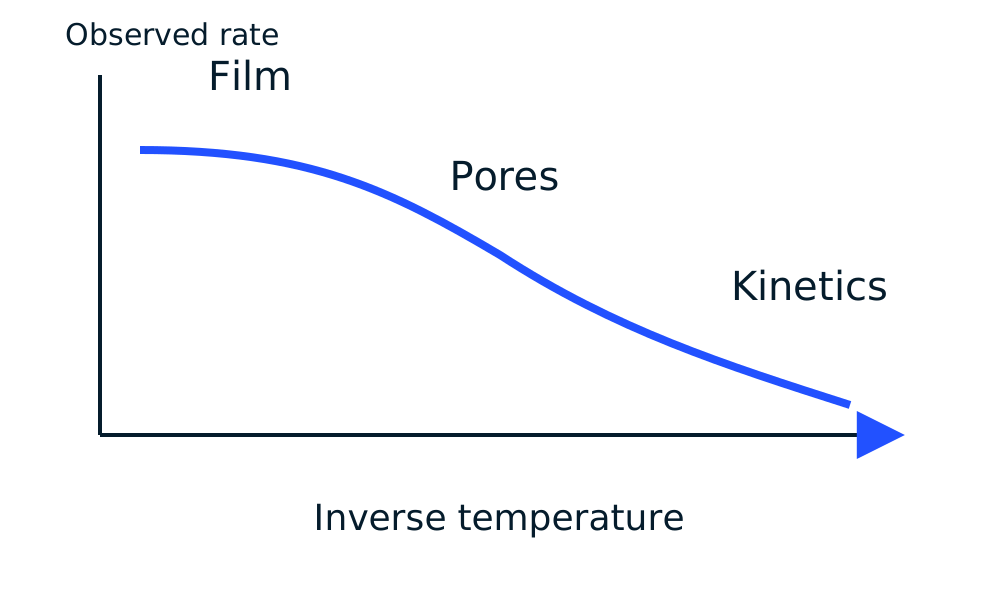 Open figure at full size (opens in a new tab)
Review the temperature and heat-transfer basis
Laboratory apparatus may exchange heat with its surroundings differently from a larger reactor. Controlled-temperature tests can be valuable for interpretation, while a larger process may experience a changing temperature through the catalyst bed. Isothermal and adiabatic descriptions are modeling or design assumptions whose suitability depends on the actual arrangement, rather than definitions determined solely by plant size.
Temperature changes can influence reaction rates and transfer effects differently. An apparent kinetic relationship obtained in one range may therefore need careful interpretation in another. Changes in catalyst particle size can also affect diffusion and heat generation. For an exothermic process, these interactions belong in a competent engineering and safety review; improved conversion in a small test does not by itself establish a suitable larger-scale design.
Connect performance targets with the proposed reactor
A catalyst target becomes more useful when it describes the intended reactor context. A proposed change in particle size, for example, may affect transfer behavior as well as the thermal response of an exothermic system. It therefore belongs in an integrated engineering and hazard review. The aim is to understand the coupled effects of the change, without interpreting a more active laboratory result as sufficient evidence for a different commercial arrangement.
Start from the commercial question and identify the laboratory or pilot evidence needed to examine it. Which feed range, operating severity, conversion or product-quality requirement matters? What behavior would make the proposed design difficult? These questions help connect research objectives with engineering limits and the economic basis. They can also show why a further model or representative campaign is needed before a result is used to support a design decision.
The source’s diagnostic tendencies
| Controlling contribution | Flow behavior | Temperature behavior |
|---|---|---|
| Film diffusion | Reⁿ (as stated in the source) | Approximately linear (source description) |
| Pore diffusion | Independent (source description) | Exponential (source description) |
| Intrinsic kinetics | Independent (source description) | Exponential (source description) |
Use the evidence to explain what can be transferred
A scale-up study can bring laboratory, pilot and other representative evidence together with a model of the intended process. Compare the tested flow, particle and thermal conditions with the proposed arrangement, then explain what supports the assessment and where extrapolation remains uncertain. This makes a performance estimate easier to review than a direct transfer of conversion or selectivity from one trial.
Starting with the larger process in mind can make the evidence requirements clearer. In practice, that means turning production and feasibility questions into an experimental program. Define which catalyst characteristics and reactor phenomena need evidence, examine how they interact and document the limits of the comparison. The useful result is a reasoned study basis with a clear account of what supports the assessment.