
Ensuring the Selection of Appropriate Lab-scale Reactor.
Different experiments need different kinds of evidence. Selecting a laboratory reactor starts with the parameter to measure and the conditions needed to interpret it.
The short version
- Define the objective, evaluation method and required accuracy before selecting equipment.
- Assess flow, temperature, pressure and concentration behavior.
- Choose an experiment that can distinguish kinetics, deactivation and transport effects.
There is no single reactor for every measurement
A laboratory reactor can help investigate reaction rate, selectivity, catalyst stability or another defined question. Those objectives may need different experimental arrangements. The useful starting point is the parameter to measure and the accuracy needed to support the next decision.
Also consider how results will be evaluated, whether operation is periodic or continuous, and how easily the equipment can be operated or reconfigured. Convenience matters, but it does not replace an interpretable test design.
Translate the objective into an observable question
An experimental objective needs an observable question. Screening candidates, estimating reaction behavior and studying how performance changes with time are related tasks, but they may call for different campaigns. The required measurement, its interpretation and the acceptable uncertainty should be considered together. This helps the team explain why a chosen arrangement is suitable and which conclusions it will be able to support.
For example, a comparison of candidates could use a clearly specified common feed and operating basis. A stability question would also need the relevant history and duration. A kinetic question needs an interpretation of the transport and thermal effects present during the test. These examples are different ways to organize evidence; they are not a standard equipment package. The appropriate arrangement follows from the information the next decision needs.
The plan can distinguish the measurement needed for an initial comparison from the evidence needed for later extrapolation. A candidate-screening result may identify an option worth studying, while the next process question requires information about a different condition or influence. Explaining that progression makes the selected reactor and campaign easier to justify and helps readers understand how each result contributes to the wider development program.
Make the reacting conditions understandable
Many kinetic investigations seek approximately ideal flow and controlled temperature and pressure. Concentration behavior also needs to be known. These conditions help connect measured observations with a model without attributing every effect to reaction chemistry.
A small reactor cannot reproduce every aspect of a commercial unit. Several experiments or complementary models may be needed to separate intrinsic behavior from mixing, heat transfer, mass transfer and time-dependent catalyst changes.
State the idealization behind the reactor description
Names such as CSTR and PFR are useful, but the actual test needs a description of its flow and reacting conditions. If the analysis assumes a uniform condition or an ideal flow pattern, explain how that assumption relates to the equipment and observations. Temperature, pressure and concentration differences can affect the interpretation even when a reactor is familiar or has been used successfully in another study.
The practical question is whether the arrangement supports the particular simplification being used. A well-mixed assumption, for example, is an interpretation to examine rather than a conclusion established by the equipment name alone. Where evidence is incomplete, keep the assumption visible and identify what could test it. This gives readers a way to understand the calculation and its limits without assuming that any laboratory reactor perfectly reproduces the intended commercial process.
Match the operating mode to the question
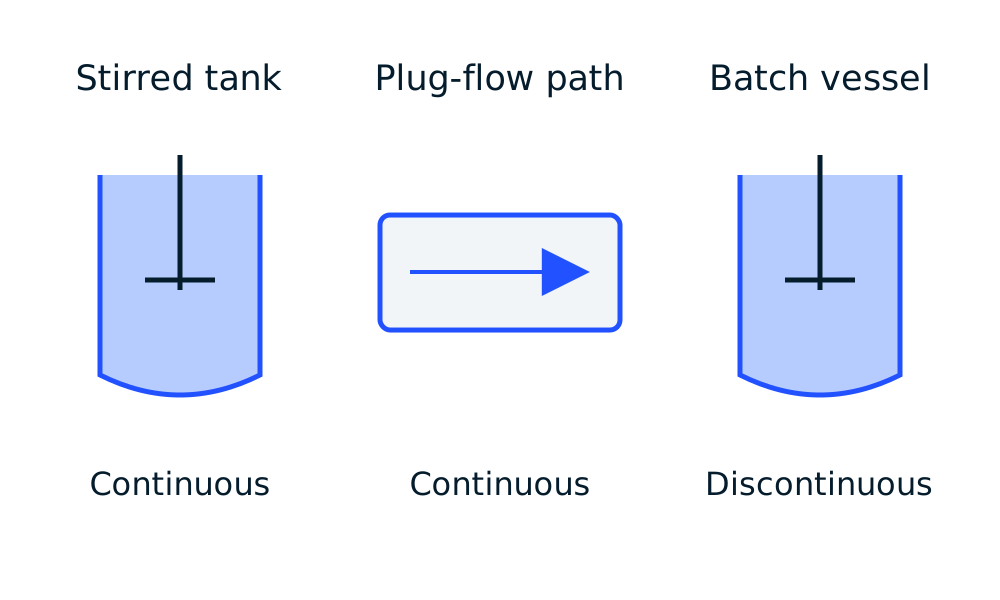 Open figure at full size (opens in a new tab)
Match the reactor to the information needed
A well-mixed continuous stirred-tank reactor can provide relatively uniform conditions and a convenient basis for certain kinetic and deactivation studies. A plug-flow arrangement can investigate behavior along a flow path when its assumptions are sufficiently supported.
A batch test changes with time, so reaction progress and catalyst deactivation may need explicit separation in the analysis. Bubble columns and fluidized beds introduce hydrodynamics that can be important to the process but may complicate extraction of intrinsic kinetics. None of these observations makes a reactor universally suitable or unsuitable.
Match the information to the experiment
| Arrangement | A useful interpretation question |
|---|---|
| Well-mixed continuous | Are mixing and thermal control adequate for the uniform-condition model? |
| Flow-path reactor | Are flow behavior and gradients represented by the selected model? |
| Batch | Can time-dependent reaction progress and deactivation be distinguished? |
| Complex hydrodynamics | Which mixing and transport effects need measurement or modeling? |
Separate changes with time from differences between conditions
Catalyst activity can change while an experiment proceeds. The measured response may therefore reflect both the operating condition and the history of the material. A comparison needs to explain when observations were made, how the catalyst was prepared and what happened between measurements. This is particularly relevant when the objective is to distinguish reaction behavior from deactivation rather than simply report an overall change.
A useful campaign plan makes the sequence of observations understandable. Record the starting basis, changes in conditions, duration and any interruptions or material changes. The resulting history allows a reviewer to ask whether two values are comparable and which influence could explain a difference. It also helps define what a later continuous, batch or differently mixed test would add to the evidence already available.
Connect each observation with its limitations
State the operating range, model assumptions and uncertainties alongside the result. This makes it easier to decide which information can inform scale-up and which questions remain open.
A good choice is the setup that can answer the intended question with defensible interpretation, rather than the one expected to answer every question at once.
Describe accuracy as a requirement for the decision
More detailed equipment does not automatically make a study more useful. The important question is whether the measurements and interpretation are adequate for the intended decision. Consider the information required, uncertainty that could change the conclusion, and practical ability to reconfigure or repeat the study. These questions connect the required accuracy with the scope and resources of the experimental program.
The report can explain the selected reactor, the measurement purpose, the operating basis and the principal limitations in one place. Include the assumptions needed for interpretation and the evidence that supports them. If a result is suitable for screening but not yet for a larger-scale design, state that distinction clearly. This supports a constructive next step: the additional observation or model work is defined by the unresolved question rather than a general preference for one reactor type.