
Unraveling the Mystery of Catalyst Deactivation: The Hidden Challenges in Catalyst Development
Initial activity is only part of a catalyst’s value. Chemical changes, deposits, particle damage and thermal effects can alter performance, so useful studies also examine stability and the conditions behind it.

The short version
- Examine activity, selectivity and useful life together.
- Different deactivation mechanisms need different evidence.
- Connect stability assumptions with process conditions and replacement or regeneration needs.
Begin with the performance that needs to remain useful
Catalyst performance is usually discussed through several connected measures. Activity concerns how readily the desired reaction proceeds; selectivity concerns the relationship between desired and unwanted products; stability concerns how that behavior develops over time. A promising result in an initial test may therefore answer only part of the development question. The process also needs evidence about the conditions under which the useful performance can be sustained.
A comparison becomes more informative when the test history accompanies the reported result. Record the feed, operating conditions, time on stream and relevant changes during the campaign. These details help explain whether two observations describe comparable situations. They also make it easier to discuss a candidate that has strong initial activity but a different stability profile, without reducing the choice to a single laboratory value.
Distinguish chemical changes
Catalyst deactivation is a loss of activity, selectivity or both. Poisoning is one possible mechanism: a component of the feed, products or impurities can interact strongly with active sites and interfere with the reaction. Depending on the catalyst and substance, the effect may develop at different rates and may or may not be reversible. Feed composition is therefore important evidence in a stability study.
Other chemical changes can also matter. Reactions involving the active material, support or promoter may form a less active phase, while some conditions can lead to loss of catalyst material through volatile compounds. A useful review distinguishes these possibilities from poisoning rather than grouping every performance decline under one explanation. Feed treatment, catalyst selection and operating conditions can then be assessed against the identified mechanism.
Poisoning can involve site blockage, a change in the adsorbing surface or restriction of reactant movement over that surface. Feed purification, including a suitable guard bed or scrubbing arrangement, is therefore a possible study direction where the identified substance and process conditions support it.
Understand deposits and access to the catalyst
Fouling occurs when material accumulates on the catalyst or within its pores. Deposits can obstruct access to active sites and change the movement of reactants. Carbon-containing deposits are an important example, but their nature depends on the reaction, catalyst and conditions. Some deposits may involve both physical blockage and chemical interactions, so the categories can overlap.
Possible responses discussed in catalyst development include reviewing feed impurities or deposit precursors, examining operating conditions and considering the catalyst’s active material, promoter or support. These are study directions rather than a standard remedy. The useful question is which evidence connects a deposit with the observed change in performance and whether the proposed response addresses that relationship under the intended conditions.
Carbon-rich deposits can originate through different reaction paths, including carbon-monoxide disproportionation or hydrocarbon decomposition and condensation. The labels carbon and coke do not establish one uniform composition. Understanding the deposit and its formation conditions helps connect a possible response with the particular fouling mechanism.
Recognize that mechanisms can overlap
The five mechanism groups provide a helpful vocabulary, but an observed performance change may involve more than one of them. A deposit can restrict access to pores while also interacting with active sites. Damage to particles can change the way the bed behaves, and temperature history can influence the material as well as the reaction. These connections are a reason to investigate the evidence rather than assign a cause from a performance trend alone.
For a practical review, separate the observation from the proposed explanation. The observation might be a change in product distribution, deposited material or the appearance of fines. The explanation could concern feed impurities, chemistry, mechanical stress or temperature exposure. Keeping those statements separate allows the team to identify what additional analysis would support a mechanism and whether several explanations remain plausible under the studied conditions.
Mechanisms can change useful performance
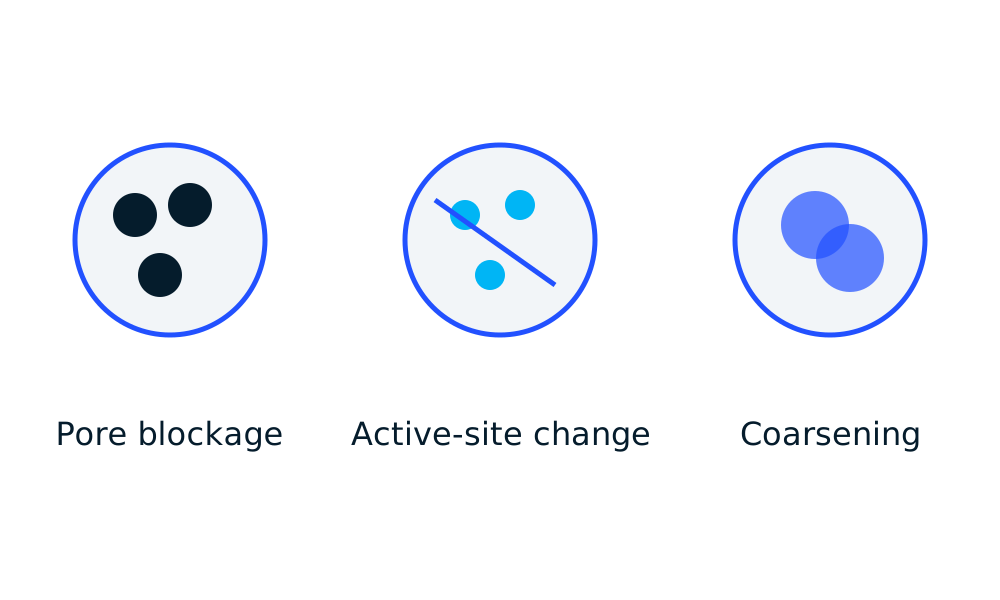 Open figure at full size (opens in a new tab)
Assess particle integrity
A catalyst may also change physically. Crushing, attrition and erosion can produce smaller particles or fines and affect the bed or surrounding process. Loads, particle collisions and fluid movement can contribute, while thermal or chemical stresses may also influence fracture. The relevant mechanism depends on the reactor arrangement and the strength and structure of the material being used.
Preparation methods, binders, coatings and suitable treatment of the catalyst are among the approaches studied to improve particle integrity. Their usefulness needs to be evaluated for the particular material and application. A development program should connect mechanical observations with performance evidence rather than assume that greater strength, by itself, establishes an appropriate catalyst for the whole process.
Plan stability evidence around the intended use
A stability study gains context from the process in which the catalyst is expected to work. Feed variations, startup and shutdown conditions, temperature exposure and the duration of operation can all shape the questions to examine. The goal is to understand the relevant operating history, not to assume that a brief or convenient test represents every future condition. The chosen campaign should make its coverage and limitations visible.
The resulting evidence can support a discussion about regeneration, replacement or a change in operating basis. That discussion also needs the resources and interruptions associated with each option. A material change that improves resistance to one mechanism may affect another property, so the comparison should retain activity, selectivity and stability together. This gives the economic review a more complete technical basis without promising a particular catalyst lifetime.
Review thermal stability and the economic implications
At elevated temperatures, changes such as particle growth, pore or support changes and transformation of the active phase can reduce accessible catalytic surface. Temperature is important, but material, dispersion, impurities, promoters and support structure can also influence the result. The study needs to consider the actual conditions and how thermal effects interact with the reaction performance being sought.
These mechanisms bring catalyst development and process economics together. Replacement or regeneration assumptions, the period over which performance is needed and the balance between activity, selectivity and stability all affect the assessment. A useful catalyst study documents the suspected mechanism, the evidence supporting it and the questions still open. This allows initial results to be discussed alongside the longer-term performance on which a process may depend.
Growth of the active material can involve particle movement, atomic movement or transport through the vapor phase, depending on the conditions. The relative contributions vary with the material and exposure. Examining these possibilities helps connect temperature history with changes in accessible surface and supporting structure.
Different mechanisms, different questions
| Mechanism | What may change | Evidence to examine |
|---|---|---|
| Poisoning | Access to or behavior of active sites | Feed components and performance changes |
| Chemical transformation | The active phase or catalyst material | Material changes under the studied conditions |
| Fouling | Surface or pore access | Deposits and their relationship with performance |
| Mechanical damage | Particle size or integrity | Fines, stresses and material observations |
| Thermal degradation | Surface, pores or supporting structure | Temperature history and material stability |