
How to Conquer the Loop of Death Valley
A shared commercial and engineering basis can help development teams connect each experiment with a clearer next decision.

The short version
- Clarify the business direction before setting technical targets.
- Translate commercial constraints into limits for process parameters.
- Keep laboratory, engineering and economic choices connected.
Begin with the direction of the business
A catalyst development program needs more than a target for laboratory performance. It also needs a clear view of the business it is meant to support. The intended commercial process and the basis for an acceptable investment should help frame the work from the beginning.
Without that connection, individual experiments can succeed while the overall development program remains uncertain. A team may improve one property without knowing whether the change helps the proposed process or its economic case. Clarifying the direction gives technical progress a context: the work is addressing a requirement that matters to the project.
Define what an acceptable process must achieve
The commercial framework should explain the economic performance the project is expected to achieve and the investment that could reasonably support it. These expectations help the team judge whether a development option is worth studying further. They also make the reason behind a technical target easier to discuss.
Keep the assumptions visible when setting that framework. A target rests on a particular view of the process and its commercial conditions. Recording that view helps distinguish a genuine requirement from an assumption that still needs examination. If the basis changes, the team can reconsider the target with a clear understanding of why.
Make the preliminary commercial view explicit
The early commercial view does not need to pretend that the final design is already known. It can describe a provisional configuration, equipment-size basis and order-of-magnitude cost assumptions using the information available. The useful distinction is between a requirement that has been established and a parameter still being explored. Showing that distinction lets the preliminary view guide research while remaining open to new evidence.
For example, the team may be able to describe the intended feed and product requirement while several catalyst-performance relationships remain uncertain. A set of preliminary design cases can make those relationships visible. Each case needs its assumptions and limitations recorded, so that a cost or performance difference can be interpreted. The exercise creates a working basis for discussion, not a final engineering package or a confirmed investment return.
A shared assumption register can record the origin of the current values, the range being explored and the reason each item matters. Research findings can then update the relevant process case instead of being added as an isolated result. The register also helps identify when an apparent disagreement concerns different assumptions rather than different interpretations of the same evidence.
Turn the constraints into useful development limits
Laboratory studies can offer considerable freedom to vary process parameters. That freedom becomes more limited when the same idea is considered at pilot or commercial scale. The development team therefore needs to understand the constraints that a larger process would introduce.
Frame critical parameters as allowable ranges, minimum values or maximum values where the evidence supports them. Engineering input can help explain which conditions are practical and which would make the proposed design difficult. The purpose is to give experimentation a meaningful boundary, while making any uncertain limit available for further study.
An early configuration and size estimate for the proposed commercial reactor can be paired with an order-of-magnitude cost view, using available laboratory evidence and design criteria. Comparing alternative design cases and sensitivities can then show which parameters most affect performance and the range of possible project returns. These exploratory estimates help frame development targets and the assumptions to test next.
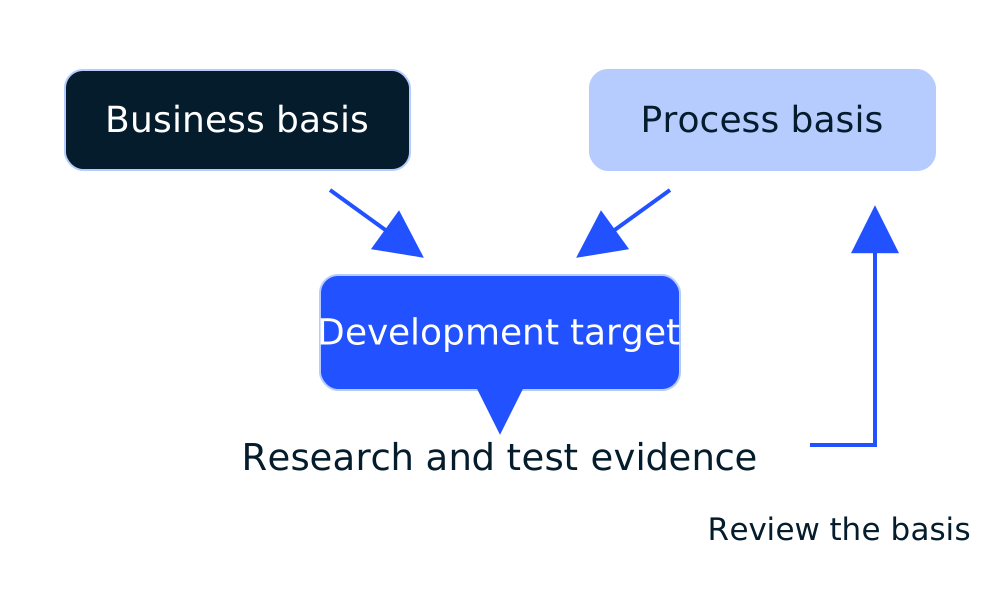
Connect development with the process and business basis
 Open figure at full size (opens in a new tab)
Use sensitivity to choose the next development target
A sensitivity study examines how a conclusion changes when an assumption or parameter changes. In the development context, it can connect laboratory targets with the behavior of the proposed commercial process. The team can ask which candidate improvement would materially affect the design or economic comparison and which would add little useful information at the present stage. This gives research priorities a clearer project context.
Alternative cases should explain what has changed and what remains comparable. The discussion can consider the range of possible project benefits and the uncertainty behind it, without presenting that range as a forecast. If an assumption strongly affects the view, it becomes a candidate for the next experiment, calculation or market check. The target is then supported by an identifiable question and a reason for resolving it.
Keep the teams working from the same basis
Business direction, economic expectations and engineering constraints are related parts of one development decision. Reviewing them together helps explain why a particular experiment is needed and how its result would influence the next stage. A finding that changes a process assumption should also prompt a review of the commercial basis affected by it.
Before the next round of work, identify the question to be answered, the condition being tested and the decision the result will support. What can the team learn at laboratory scale? What will require a pilot study? Keeping these questions connected can make each development cycle more purposeful and the path toward scale-up easier to understand.
Keep the research boundary adaptable
A development limit can be useful without becoming permanent. It rests on the current understanding of process constraints, commercial requirements and available evidence. New information about feed conditions, catalyst stability or the proposed market may justify a different limit. Recording the reason behind a target makes that change understandable and prevents a revised requirement from appearing as an unexplained shift in direction.
The shared review can summarize the current basis, the most influential uncertainties and the decision expected from the next work. Research, engineering and financial readers can then see how their questions connect. This supports a constructive development cycle in which experimental learning and the commercial view inform each other. It does not remove uncertainty, but it makes the purpose of another cycle and the evidence needed to assess it much clearer.
Connect the next test with the decision
- 01Business direction
Clarify the commercial process and need the work is meant to support.
- 02Economic basis
Make the investment and performance expectations visible.
- 03Engineering limits
Describe the larger-scale conditions that constrain the option.
- 04Test question
Identify which uncertainty the next experiment should address.