
Tank or Reactor Changes: What to Check Before Restart
A new part is in place. The crew has left. Before production starts again, what should the person approving the restart have in front of them?

The short version
- Ask the responsible engineer to confirm what the changed equipment has been approved to do.
- Match the inspection reports, test results, and final drawings to the equipment on site.
- Resolve the safety conditions required for startup, then record who accepts the restart and why.
The cover is fitted. The handover is still open.
Suppose a contractor has just fitted a new cover to a reactor. Production is waiting for another batch. At handover, the drawing turns up quickly. Finding the test report takes longer. Then someone remembers an email about a limit on operating pressure.
There may be a sound answer to every question. The person approving restart still needs to see those answers together. Which cover was tested? Does the approval allow the way production plans to use it?
That is the handover problem we are looking at here. Finishing the installation leaves a decision to make.
Why an old accident is in the news again
On 19 October 2026, the U.S. Chemical Safety Board issued an update on Yenkin-Majestic/OPC Polymers. It said the company had neither implemented nor substantively responded to its five safety recommendations. The update concerned the April 2021 explosion at the company’s Columbus, Ohio resin plant. The investigation findings appeared in November 2023. This was a follow-up on those recommendations.
The CSB’s findings included a reactor access cover that had not been properly designed, built, or tested. It also found failures in pressure-vessel quality assurance. In plain language, those are the checks that establish whether the design and construction meet requirements.
The subject is also on the conference agenda. An asset integrity session at the 2026 AIChE Global Congress on Process Safety includes quality assurance and dealing with defects. Asset integrity means keeping equipment fit for its job. The program signals interest in these issues; it does not introduce a new standard.
Before restart, connect the evidence
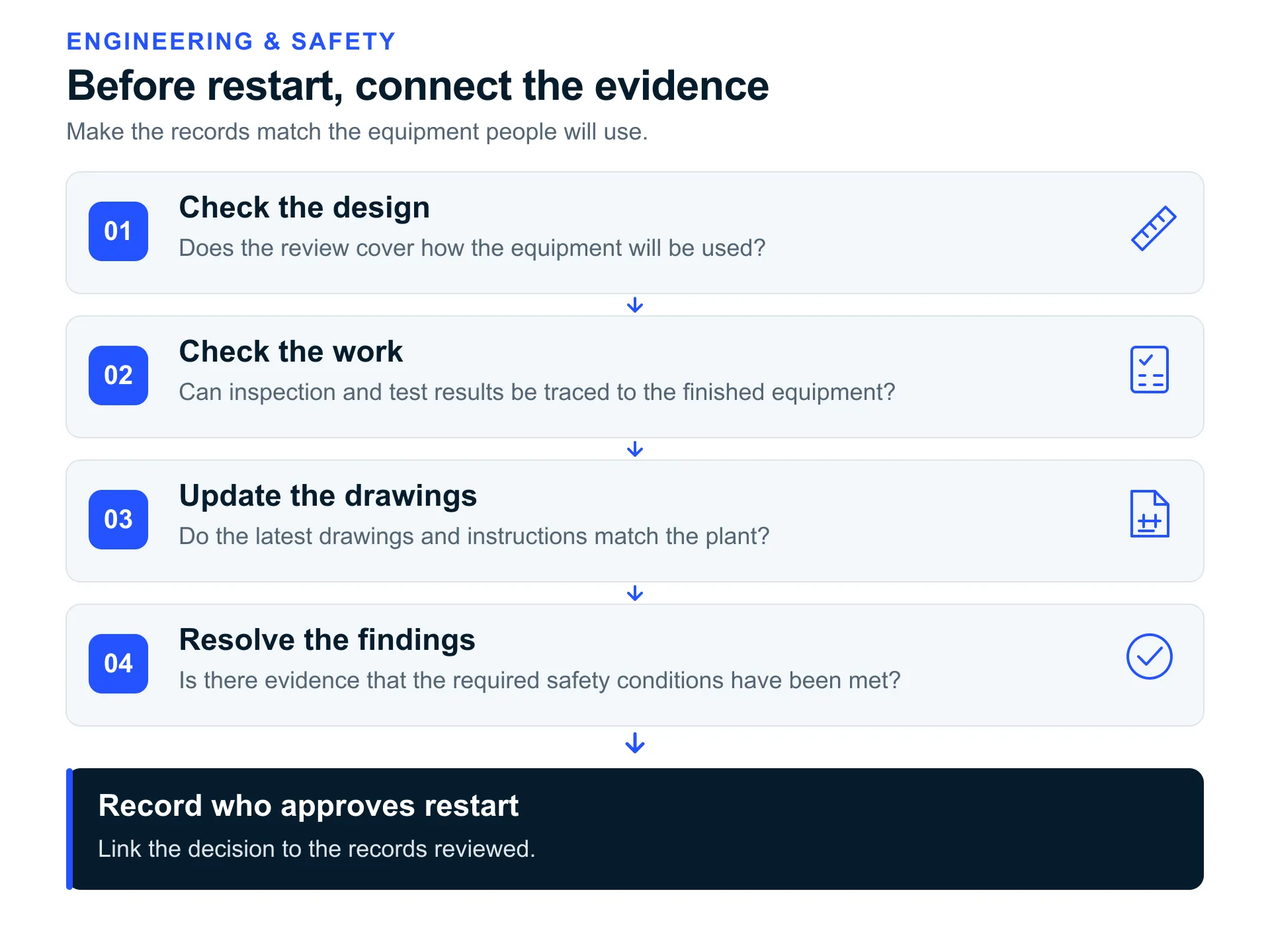 Open figure at full size (opens in a new tab)
1. What has the engineer approved?
At OSVARD, we would first ask for the responsible engineer’s review. It needs to name the equipment and the approved change, then explain the materials and process hazards involved. Look for the pressure and temperature considered, the assumptions behind the assessment, and the limits the operators must follow.
The new part may affect more than its immediate surroundings. A connection can change loads on a vessel, access to it, or how it can be isolated. Safety devices and systems may be affected too. For a reactor, the reaction itself and the order of operating steps may need another look.
How much review is needed depends on the change, the equipment, and the rules that apply. The question to settle is whether the assessment covers the conditions the equipment will face in use.
2. Make the report match the equipment
Open an inspection or test report beside the equipment. You should be able to tell which item it covers, when it was checked, how, by whom, and with what result. There also needs to be a clear basis for passing. If the work differed from the approved design, find out how that difference was dealt with.
Let the engineer’s assessment determine the records needed. These might include material identification, welding and examination reports, measurements, or tests of the safety devices and systems affected by the work. The list will vary from one change to another.
Be careful about what a test result tells you. A pressure test covers the conditions tested. It cannot establish that the entire operating cycle is safe. Any test that is required needs its own suitable procedure and controls.
3. Leave the next shift one clear set of drawings
An as-built drawing is a drawing of what was actually installed. Its connections, components, and equipment details need to match what is in the plant. The next shift needs the current approved revision and a clear place to find it.
Marks made on drawings during construction can be useful while the work is going on. Before restart, agree on a controlled record of the finished installation. Update the affected operating limits, inspection plans, and instructions as well. Nobody on the next shift should have to guess which version to trust.
4. Ask what happened after the contractor was contacted
“Contractor contacted” is a perfectly reasonable progress note. On its own, it leaves the original concern open.
Every finding needs an owner, a description of the evidence required, a clear statement of what is acceptable, and a person to check closure. For a design concern, that may mean an approved assessment followed by a check of the installation. For a safety device or system, it may mean a test result and someone’s acceptance of that result.
A safety condition required for restart must be met and checked before the equipment goes back into service. Some other work may legitimately wait. Where that is allowed, write down the reason, the controls, the owner, and the due date. The person approving restart needs to know which is which.
Questions to answer before restart
| Question before restart | Records to check |
|---|---|
| Does the design cover the intended use? | Responsible engineer’s review and operating limits. |
| Was the finished work checked? | Inspection and test results checked against the agreed requirements. |
| Do the documents match the equipment? | Approved final drawings and updated instructions. |
| Have the restart conditions been met? | Evidence of resolved findings and decisions on permitted open work. |
| Who approves restart? | Named authorized person and the records behind the decision. |
5. Start with the operator’s job
An operator should be able to pick up the approved instructions and explain their own job during startup. Training has to prepare the people affected by the change. Check both the instructions and the training for any changes to operating limits, alarms, shutdown actions, or maintenance tasks.
Then go to the equipment. Check its connections and setup, whether it is back in the required operating arrangement, and any temporary arrangements still present. This final walk around the plant is often called a walkdown.
Leave time for questions from operations, maintenance, engineering, and safety. Any unanswered question needs evidence to settle it before the equipment is accepted.
6. Write down the decision while the answers are clear
An “OK to start” message would leave too much unexplained. We would want the restart record to name the person with authority to approve it and the particular change being accepted. It also needs links to the evidence reviewed. Keep the operating limits, the resolved findings, and any decision to accept work as still open with that approval.
A U.S. process covered by the OSHA Process Safety Management standard must have a pre-startup safety review if a modification is significant enough to require changes to process safety information. That means the recorded information about the process and its hazards. The standard also has management-of-change rules for changes within its scope. Every facility still has to follow its local law, applicable codes, and site rules.
Think of a colleague joining the team a year later. We would want that person to see what changed, how it was checked, and why it was accepted for that use. The answer should be in the record, without a search through everyone’s old emails.