Fire load represents the total energy content of combustible materials in a given area (usually expressed in kilojoules or megajoules per square meter of floor area). In simple terms, it’s a measure of how “much fire” a space could produce if all the fuel in it burned. This includes not only the contents (furniture, stock, flammable liquids, etc.) but sometimes the combustible parts of the structure itself. Fire load density (also called fire load per unit area) is calculated by summing the calorific value of all combustibles in a compartment and dividing by the floor area. For example, a warehouse storing paper will have a higher fire load (per square meter) than an office with minimal combustibles. Fire load is a fundamental metric in fire safety engineering because it correlates with fire severity and duration. A higher fire load means a fire can burn hotter or longer, which influences how we design structural fire resistance (e.g., how long must beams and columns withstand a fire before failing) and what firefighting measures are needed. It’s used in codes and engineering analyses to classify occupancies (low, moderate, high hazard) and to determine requirements like fireproofing ratings, sprinkler densities, and fire brigade needs. By quantifying the worst-case heat energy release, engineers can predict the heat impact on structures (for instance, will a steel beam reach critical temperature?) and on containment (will fire walls hold?). In performance-based design, fire load calculations might feed into developing a design fire scenario for simulation – i.e., defining how big the fire’s heat release rate could get. In summary, knowing the fire load allows one to estimate how severe a hypothetical fire would be, which is crucial for ensuring safety measures are robust enough.
When OSVARD conducts a Fire Load Calculation, we start by surveying the space in question. We itemize all combustible materials present: this includes obvious fuels like stored products (wood, plastics, textiles, chemicals), packaging materials, and furniture, but also less obvious contributions like wall/ceiling linings, insulation, cables, and any plastic components of equipment. Each material has a known or estimated calorific value (energy per unit mass, often in MJ/kg). We determine the mass or volume of each combustible and multiply by its calorific value to get the total energy content. For accuracy, we might use standards or references for typical calorific values (for example, wood ~17 MJ/kg, plastics ~30 MJ/kg, diesel ~45 MJ/kg). If needed, laboratory testing can be done for unusual materials. We then sum these energies and divide by the floor area of the compartment (sometimes considering only the “fire compartment” if the area is subdivided by fire-resistant barriers). The result could be, say, 800 MJ/m². How do we interpret that? It might be compared with code classifications (some codes consider > 1,000 MJ/m² as high hazard, for instance). But beyond code, OSVARD uses the fire load to inform engineering decisions. We may calculate a “design fire” based on fire load – for example, using the fire load and ventilation conditions to estimate a fire’s heat release rate curve over time (a parametric fire model). Fire load affects how long a fire can burn at a given intensity; a very high fire load means even if sprinklers control the initial fire, there’s a large fuel reserve, so extended monitoring and cooling might be needed.
We also consider fire load distribution: is it uniformly spread or concentrated? A stack of pallets in one corner concentrates fuel (possibly leading to higher local temperatures). OSVARD may perform zone model or CFD simulations using the fire load to see how hot the upper layer gas temperatures get and how quickly. This helps in verifying if structural elements with certain fire ratings (e.g., a column with a 2-hour fire rating) would survive. Furthermore, our calculations feed into fire protection system design: for instance, sprinklers are designed with a density (mm/min) and area of coverage based on occupancy hazard categories, which are related to fire load and expected fire intensity. If we find an exceptionally high fire load that exceeds normal ranges for an occupancy, we might recommend upgrading sprinkler system classification or adding additional measures (like automatic deluge systems or fire partition walls to break up the fuel continuity).
By quantifying the fire load, OSVARD ensures that all fire safety measures are tailored to the real risk. If a client’s facility has increased storage of combustibles over time (say a warehouse now storing more plastics than before), a new fire load calc might show the site has moved from “Ordinary Hazard” to “Extra Hazard” classification – prompting upgrades to sprinklers, fire alarm systems, and fire-fighting access. We also guide clients on how to manage fire load: for example, if certain areas have exorbitant fire loads, we might suggest physically segmenting those with fire-rated barriers to confine worst-case fires. Another recommendation can be inventory management – not exceeding certain storage heights or quantities in one area to keep fire load per compartment under control. Structural fire engineers on our team will take the fire load data and ensure that building elements (columns, floors) have appropriate fire resistance rating (FRR). For specialized facilities like chemical plants, we use fire load and scenarios to design passive fire protection on equipment (like fireproofing on pressurized vessels to prevent rupture before emergency depressurization, accounting for the thermal exposure from nearby burning fuel).
Ultimately, fire load calculations give both the client and the authorities confidence that the facility’s fire safety design is based on quantitative risk. It helps answer questions like: Can my building withstand a fire until firefighters arrive? Will the fire suppression systems control the fire given the amount of fuel present? With OSVARD’s comprehensive analysis, if gaps are found – perhaps the fireproofing is insufficient for the calculated fire duration – we provide clear recommendations to close those gaps, such as increasing fireproofing thickness or adding structural reinforcement. In doing so, we turn what could be an abstract number (MJ/m²) into actionable safety improvements. Clients in Asia benefit from this rigorous approach by achieving compliance with fire safety codes (which increasingly allow or require performance-based designs) and, more importantly, protecting lives and property from devastating fires. OSVARD’s meticulous fire load assessments thus form a critical piece of the overall fire risk management puzzle, ensuring no assumption is made about fire severity – it’s calculated and prepared for.
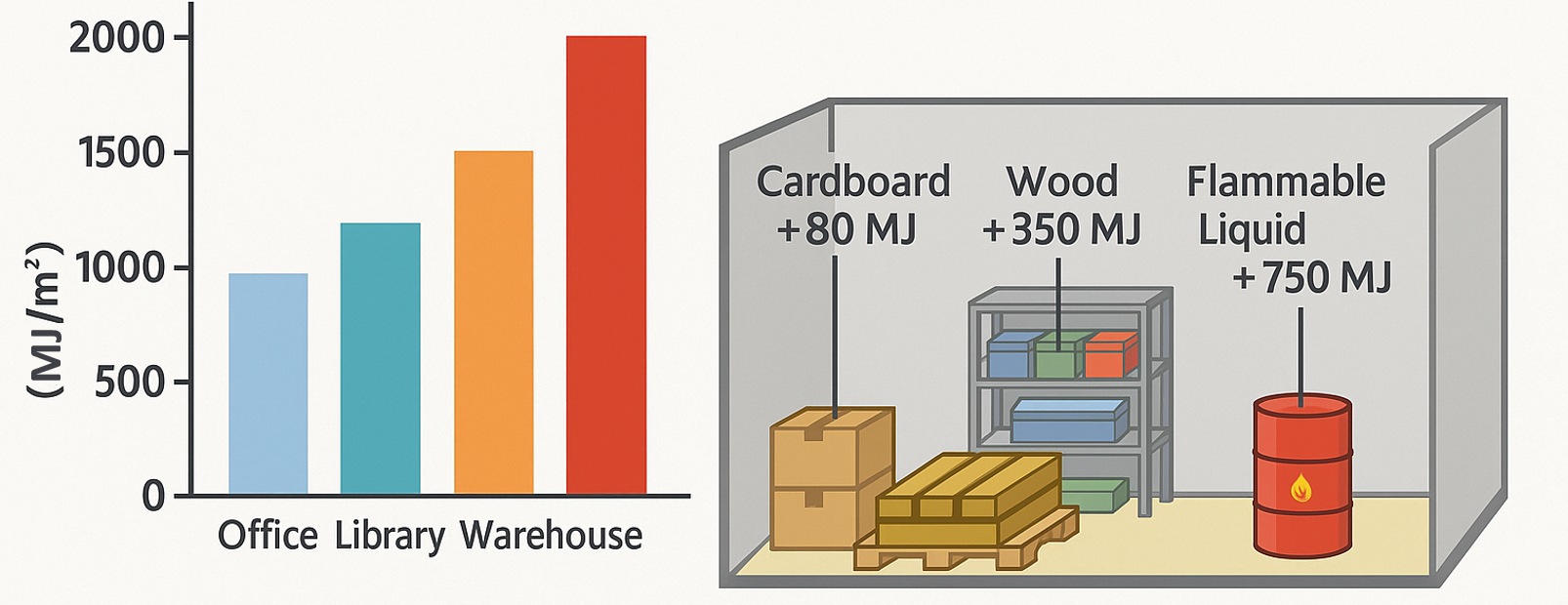
Consultivo – Fire Load Calculation is fundamental for assessing fire risks, intensity, and probable fire duration; it quantifies the heat energy per area from complete combustion of contentsconsultivo.inconsultivo.in.
Consultivo – The fire load (heat energy per square meter, in kJ/m²) is derived from the calorific value of materials present and indicates the potential severity of a hypothetical fireconsultivo.in.
Consultivo – Fire load density is used in models to understand fire severity and to plan preventive and mitigation measures effectively (e.g., determining required fire resistance, sprinkler design)consultivo.inconsultivo.in.