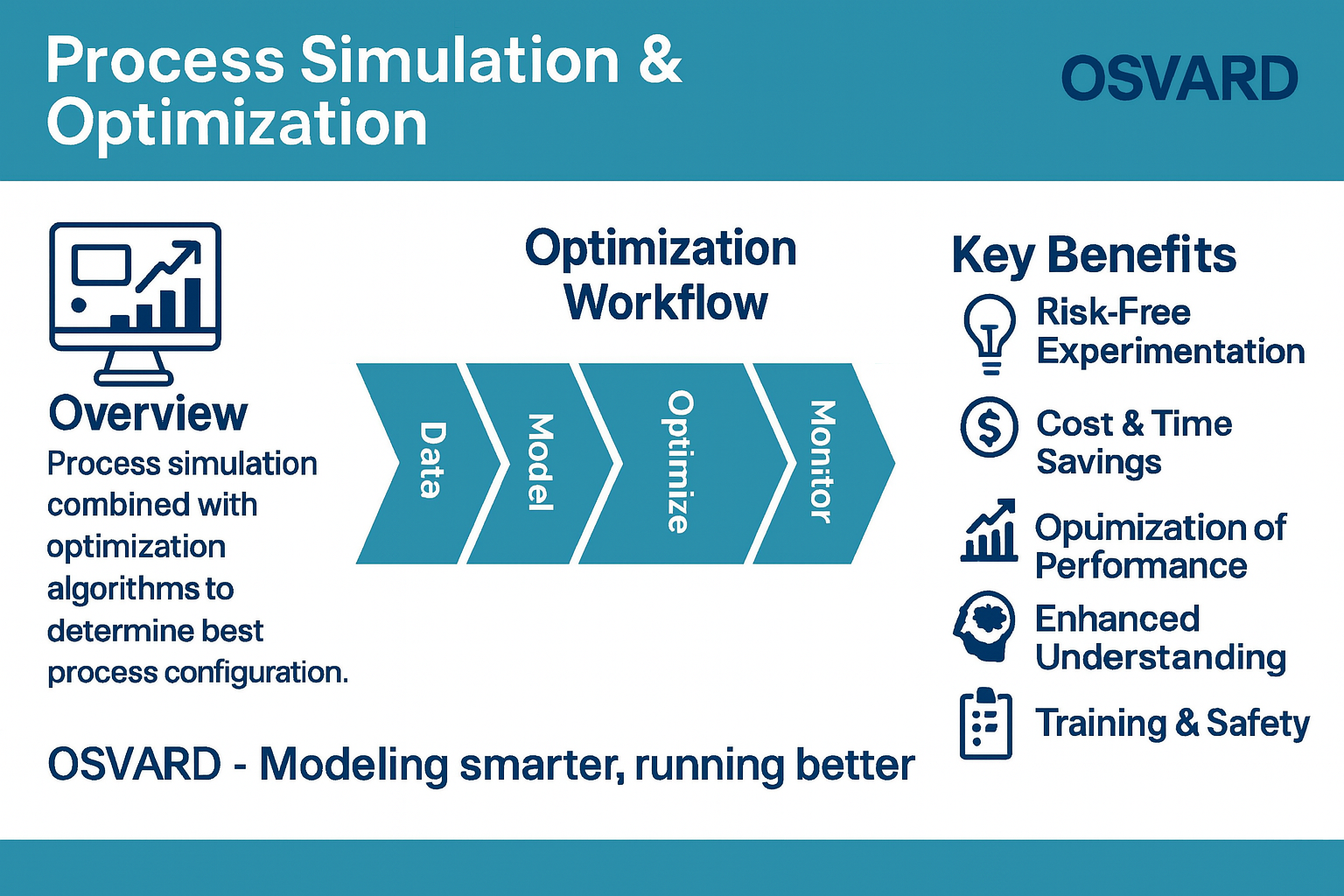

Process Simulation & Optimization: From Virtual Trials to Real-World Wins
Most plants already use simulation to check if a design will work. Adding optimization turns that model into a decision engine—one that searches millions of what-ifs and points to the single best answer for cost, capacity, energy, or all three at once. OSVARD pairs deep process know-how with math-driven algorithms so your projects move from “looks fine” to “runs at its absolute best.”
Why Simulation Alone Isn’t Enough
A digital model shows how the process behaves, but it still leaves engineers to pick set-points by intuition. In complex systems—multiple reactors, recycle loops, heat-integration trade-offs—gut feel can miss hidden savings. Optimization layers a solver on top of the model, systematically exploring every variable and constraint until it finds the sweet spot.
Where We Push Performance
-
New-plant design – Right-size equipment, pick the best pressures, and minimize both capex and opex before a single flange is cut.
-
Day-to-day operation – Locate the profit peak for an existing unit: optimal temperatures, flow splits, and recycle rates that squeeze extra tonnes out each shift.
-
Debottleneck choices – Compare dozens of fix-it options (bigger pump, more cooling, feed split) and rank them by dollar-per-ton benefit.
-
Supply-chain planning – Sequence multi-product campaigns or energy-network loads to shave downtime and utility bills.
How OSVARD Gets It Done
-
Scope & data check
We define goals—cut steam 10 %, lift capacity 5 %, hit both—and gather plant data to anchor the model in reality. -
Build or refine the digital twin
Aspen, gPROMS, or Python-based models capture kinetics, hydraulics, and heat recovery exactly as your plant sees them. -
Choose the right solver
-
Non-linear programming for smooth, continuous variables
-
Mixed-integer programming for yes/no decisions (add a column, open a spare line)
-
Evolutionary algorithms when the search space is huge or discontinuous
-
-
Run virtual experiments—fast
Millions of scenarios play out overnight, all within safety and quality limits. -
Validate & sanity-check
Experienced engineers review every “optimal” answer to be sure it’s practical to control and maintain. -
Deliver clear actions
We hand over new set-points, equipment specs, or control recipes—plus simple tools (often Excel or web dashboards) so the team can tweak targets as prices or feeds change.
Typical Paybacks
-
Energy network optimization – 8 % fuel cut, six-figure annual savings.
-
Reactor feed re-balance – 4 % throughput boost with zero new steel.
-
Distillation revamp – 5 % lower steam after fine-tuning stages and reflux.
-
Batch profile tuning – 30 % shorter cycle times, freeing hidden capacity.
Most projects repay themselves in months, not years—and the gains keep compounding.
What You Walk Away With
-
Fact-based decisions instead of hunches.
-
Trade-off clarity—see exactly how cost, yield, and emissions shift together.
-
Adaptable tools that plant engineers can rerun when markets or feedstocks change.
-
A proven path to squeeze more value from assets you already own.
“Optimize in the simulator today, profit in the plant tomorrow.”
Ready to uncover the best your process can be? OSVARD’s Simulation & Optimization team is here to run the numbers—and turn them into real-world rewards.