
Engineering lower-carbon, lower-waste plants—without surrendering profitability
Global net-zero commitments are forcing the process industries to rethink everything from molecule choice to heat-exchanger placement. For small and mid-sized manufacturers, that can feel daunting: new regulations, carbon-pricing uncertainty, and customers who now ask for a cradle-to-gate footprint alongside the purchase order. OSVARD’s Sustainable Design & Emissions service helps you tackle those pressures head-on—turning greener chemistry and sharper energy use into competitive advantage.
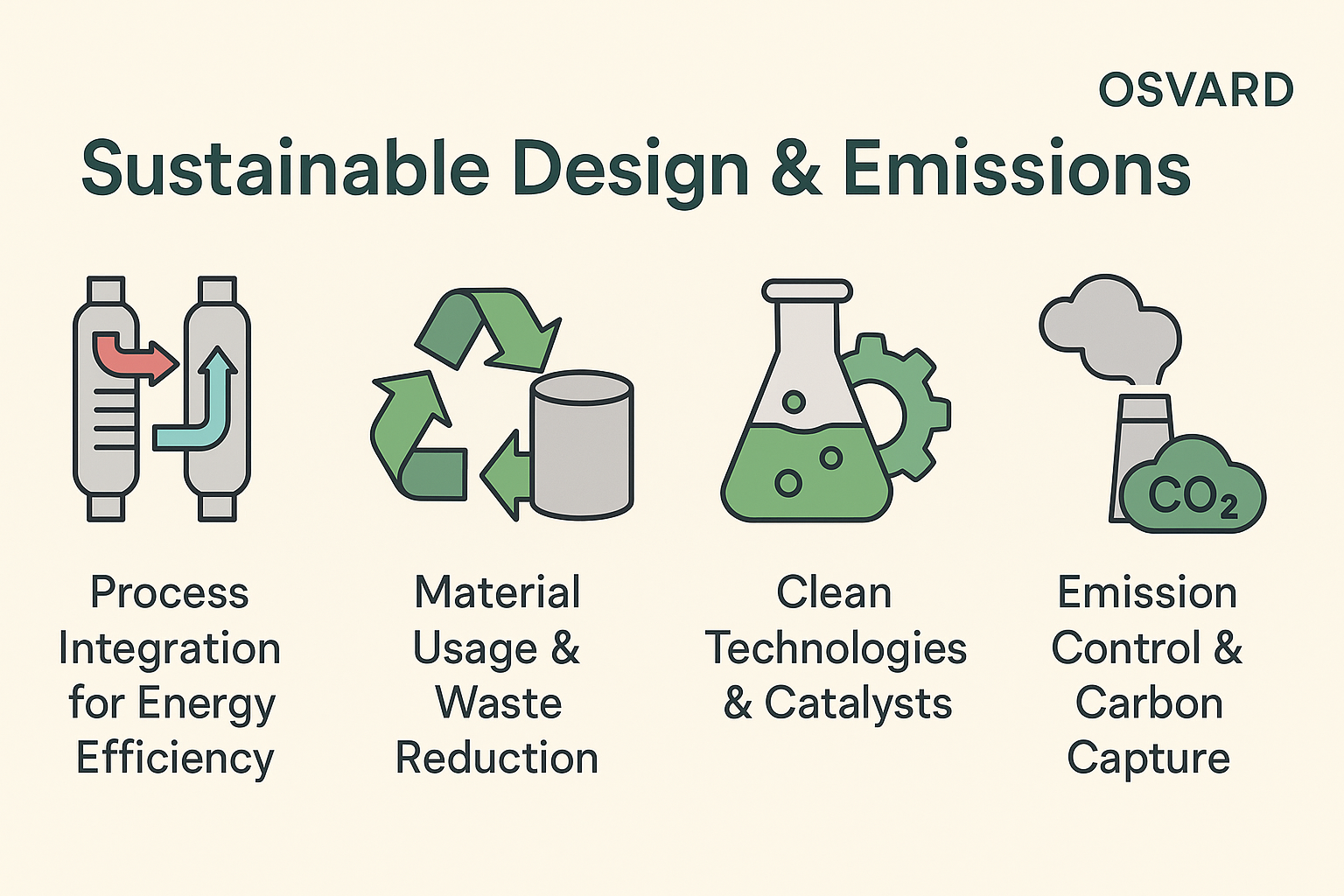
We start by mapping every kilowatt and kilojoule with pinch analysis, then redesign heat-recovery loops so waste energy from one unit warms the next. Plants typically see 10–20 % fuel savings—emissions down, margins up.
Unreacted streams, purge gases, or side products are rarely pure “waste.” We model how they can re-enter the process or become salable co-products, converting treatment costs into revenue and slashing disposal emissions.
Sometimes sustainability means a wholesale pathway change—say, moving from chlorinated solvents to aqueous media, or adopting a low-temperature catalyst that cuts furnace duty by half. We vet each option’s ROI and LCA impact before you spend a single dollar on trials.
Energy efficiency and feedstock optimisation are always Step 1. Only then do we layer in carbon-capture or utilisation for the irreducible CO₂. Our simulation tools predict absorber size, solvent load, and compression duty so you know the true cost per tonne avoided.
From high-temperature heat pumps to electric boilers fed by rooftop PV, we weigh CapEx, grid stability, and carbon intensity to craft transition plans that keep production humming while grids decarbonise.
We integrate CEMS and historian data into live dashboards, flagging excursions before they threaten compliance and allowing operators to see—in the moment—how their tweaks shave tonnes of CO₂.
Switching to a bio-feed or recycled solvent only helps if upstream impacts don’t wipe out the gain. OSVARD runs ISO 14040-compliant Life-Cycle Assessments so you see the full picture—energy, water, toxicity, land use—from cradle to grave. The outcome guides procurement specs, supplier audits, and even product marketing claims.
Aspen Plus® / HYSYS® for energy-material balances
Pinch-analysis software for minimum-utility targets
CFD to tame NOₓ and optimise burner shapes
Genetic-algorithm optimisers for multi-objective trade-offs (cost × CO₂ × yield)
Dispersion models to validate local air-quality impact
LCA suites (SimaPro, openLCA) for cradle-to-gate emissions
Coatings plant, Thailand – VOC recovery retrofit captured 95 % of solvents, cutting vent emissions to near-nil and paying back in 18 months via solvent reuse.
Oleochemical facility – Simple pH tweak plus separator loop halved wastewater COD and regained 4 % product yield.
Greenfield specialty chemicals – Combined-heat-and-power base design + solar-ready utilities delivered a sitewide carbon intensity 30 % below sector baseline.
Baseline audit – energy, raw-material, and emission mapping.
Quick wins – low-CapEx integration tweaks delivering < 2-year payback.
Mid-term shifts – catalyst upgrades, electrification, solvent swaps.
Long-horizon moves – CCU, green-hydrogen feeds, full renewable integration.
Each step is backed by EBITDA impact, carbon savings, and risk scoring so board approvals are data-driven, not faith-based.
“Sustainability isn’t a tax on your process—it’s an engineering problem with a profit margin hidden inside.”
Whether you need a single heat-integration study or a cradle-to-gate decarbonisation master plan, OSVARD brings the models, the practical plant know-how, and the financing insight (green loans, carbon credits) to turn environmental targets into bankable reality.