Demo Plant

On this Page :

Demonstration Plants: The Final Dress Rehearsal Before Full Production

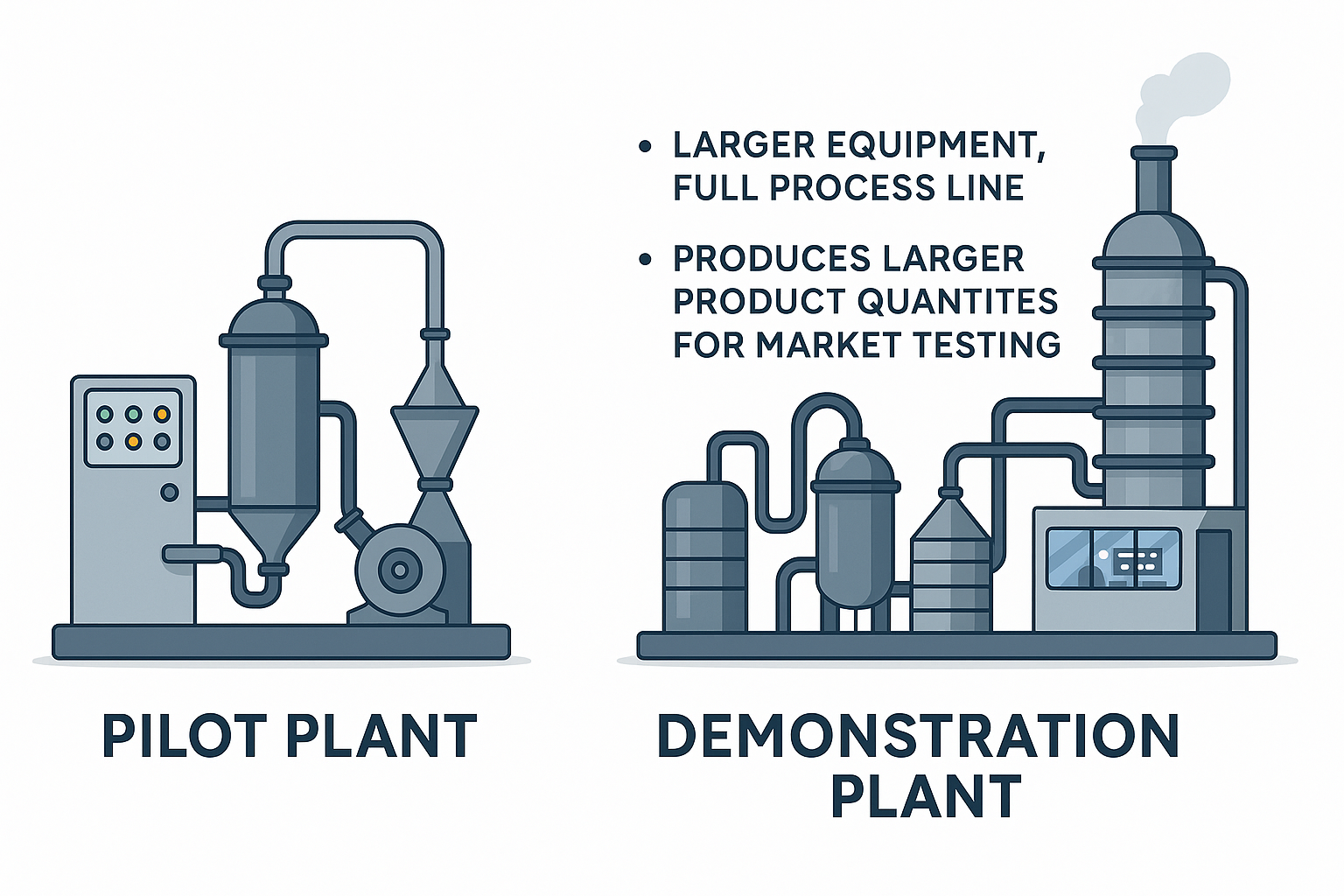
A Demonstration Plant (often called a demo plant) is the critical bridge between a small pilot unit and a full commercial facility. It operates at near-commercial scale, typically handling 10–50 % of the target plant’s throughput, and it runs long enough to prove that every part of the process works in the real world. In short, it is where bright ideas either pass the last trial or go back for a rethink.


Why a Demo Plant Matters

  • Investor Confidence
    When investors see real product flowing through industrial-grade equipment, skepticism melts away. Data collected at this scale carry much more weight than lab or pilot results.
  • Market Testing
    Volumes from a demo plant—whether barrels of biofuel or tons of alternative protein—are large enough to ship samples to potential customers, secure certifications, and gather feedback.
  • Full-Integration Proof
    Heat transfer, fluid flow, and control loops behave differently at scale. A demo plant exposes hidden bottlenecks so surprises don’t appear in the multi-million-dollar build.
  • Learning Under Real Conditions
    Extended runs uncover catalyst aging, membrane fouling, or enzyme deactivation that short pilot trials can’t reveal. Operators gain first-hand experience with procedures, safety, and maintenance.

Inside OSVARD’s Demo-Plant Philosophy

OSVARD treats demonstration facilities as “mini commercial plants” built for learning. Our engineers apply four simple rules:

Design Focus What It Means for You
Industrial-grade equipment Pumps, vessels, and controls match commercial specs so scale-up formulas translate directly.
Data-first layout Extra sensors and sample points provide hard numbers for every mass and energy balance.
Built-in flexibility Spare nozzles and tie-points let you test different feedstocks or operating windows without cutting metal.
Long, steady campaigns Units run months, not days, to verify reliability, maintenance needs, and product quality drift.

A Real-World Case Study

  • Sector: Biofuels

  • Demo Scale: 25 barrels per day

  • Objective: Validate continuous catalyst life over three months and supply engine-test samples to an automotive partner.

  • Outcome: Less than 2 % catalyst deactivation, fuel met ASTM specs, and the data unlocked USD 80 million in Series C funding.

Another example comes from water treatment. Singapore’s NEWater membrane demo plant produced 10 000 m³ day⁻¹ of ultra-clean water back in 2000. Continuous operation proved reliability at scale and cleared the way for full-scale adoption that now supplies up to 40 % of the nation’s potable water.


Design Details that Make—or Break—Success

  1. Geometry Matters A 5000 L fermenter with the same height-to-diameter ratio as the future 50 m³ bioreactor ensures oxygen transfer and mixing behave the same way. Without matching geometry, “good” lab results can turn into costly surprises.
  2. Control Systems Mirror the Future We install PLC and DCS architectures identical to commercial units. Operators learn real control logic, while engineers tune loops that will be copied verbatim later.
  3. Safety by Design All demo plants follow pressure-vessel codes, fire zoning, and—where relevant—GMP layouts. Emergency-shutdown logic is stress-tested before the first drop of feed enters.
  4. Provision for Product Handling Packaging lines or drum fillers are integrated from day one. You can ship product for regulatory tests, consumer panels, or small-batch sales without adding temporary rigs.

The Unexpected Bonus: Early Cash Flow

Because a demo plant is built to commercial standards, you can often sell the first product. Revenue, even if modest, offsets operating costs and strengthens your business case with financiers.


OSVARD’s End-to-End Support

  1. Process Design & HAZOP
    We finalize heat- and mass-balance models and run a full hazard review to lock in safe, efficient operation.

  2. Detailed Engineering & Procurement
    OSVARD’s supply-chain team sources industrial-grade equipment, ensuring delivery dates match construction schedules.

  3. Construction & Commissioning
    Our site supervisors manage contractors, while process specialists oversee tie-ins, hydrotests, and functional checks.

  4. Operations & Data Analytics
    Once live, OSVARD engineers stay on site (or monitor remotely) to troubleshoot, fine-tune, and interpret data.

  5. Scaling Blueprint
    Every finding—good or bad—is rolled straight into the full-plant design package, turning lessons learned into risk-free scale-up.


Key Takeaways

  • A demo plant is the last test-drive before you “buy the factory.”

  • It cuts risk by proving technology, economics, and safety at realistic capacity and duration.

  • OSVARD’s custom demo plants deliver the data, confidence, and early revenues needed to move smoothly into commercial production.
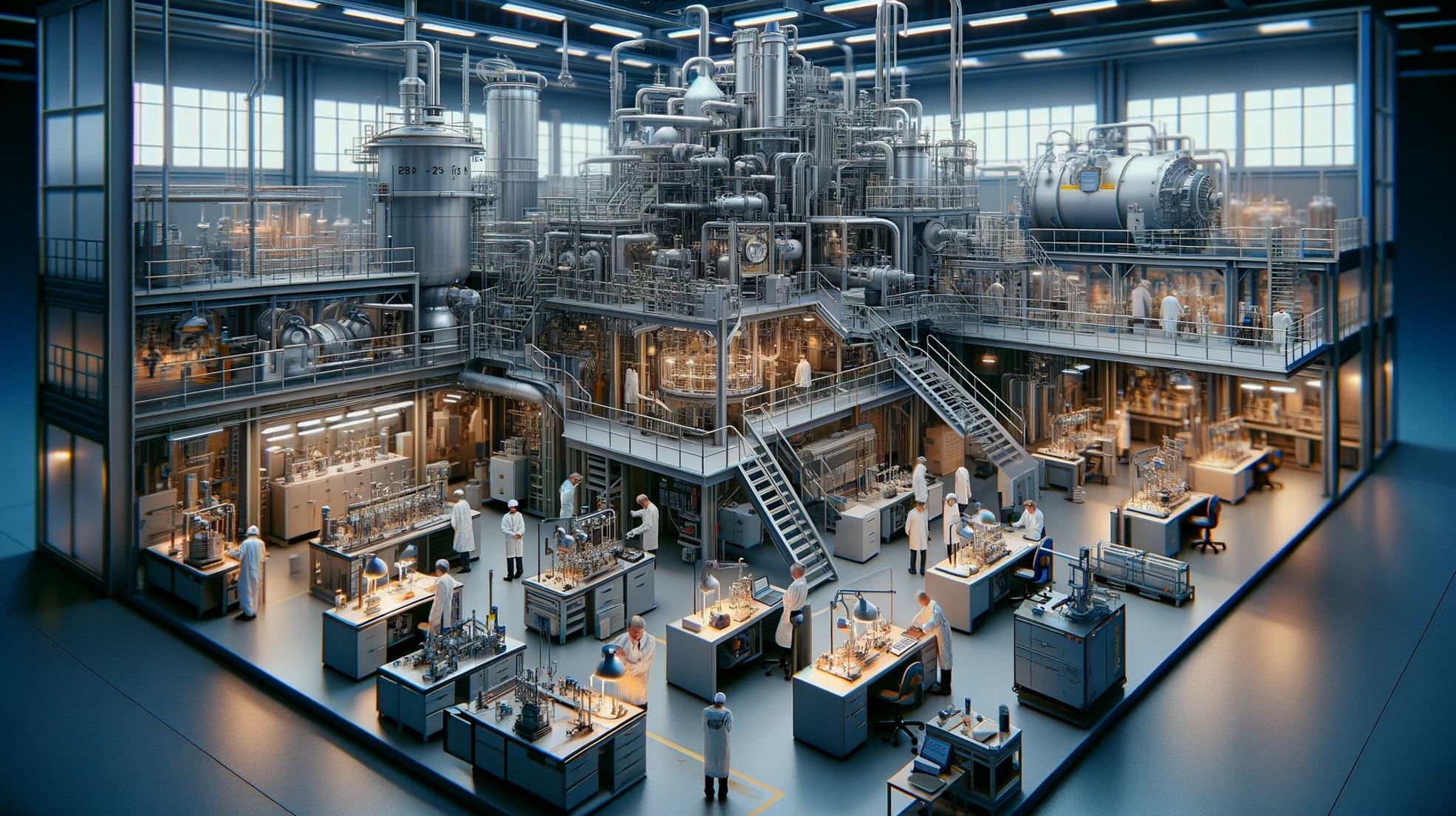
ภาพที่สร้างขึ้น

Connect with our
Competency
Connect
featured insights
Process Scale-Up
Article
Bridging the Gap – Understand a Key Differences Between a Small Beakers to Larger Sizes.
The journey from a laboratory experiment to a commercially viable process is challenging step i.....
OSVARD
Process Scale-Up
Article
Bridging the Gap – Understand a Key Differences Between a Small Beakers to Larger Sizes.
The journey from a laboratory experiment to a commercially viable process is challenging step i.....
OSVARD
Engineering Design
Article
Why is Ideal flow pattern crucial for upscaling Fixed-bed reactor ?
The challenge in fixed-bed reactor scale up is partial similarity of laboratory, pilot, and commerci
OSVARD
Process Scale-Up
Article
What are Main Differences between Lab, Pilot, Demonstration and Commercial Plant in A Nutshell ?
Nowadays, many companies have been constantly transforming from production-and operation-based compa
OSVARD
Chemical Technology Development
Article
The Key Concern with Biofuels
Biofuels like ethanol and biodiesel have been getting a lot of attention. Ethanol is often mixed....
OSVARD
Chemical Technology Development
Article
A Practical Guide to Create a Reasonable Marketing Plan for Chemical Technologies
For natural scientists and engineers, it sometimes might be difficult to become with marketing, ....
OSVARD
Engineering Design
Article
Unraveling the Mystery of Catalyst Deactivation: The Hidden Challenges in Catalyst Development
Catalyst deactivation, the process whereby a catalyst loses its catalytic activity and/or select....
OSVARD
Simulation and Digitalization
Article
Scaling the CCS: What are Technical Challenges ?
Carbon Capture and Storage (CCS) is a technology for reducing carbon dioxide (CO2) from various emii
OSVARD
Safety Engineering
Article
Ensuring isothermality is important in lab and pilot-scale tests.
In catalyst development, laboratory and pilot plant are generally used for producing reliable inform
OSVARD
Simulation and Digitalization
Article
Understanding about “Levelized Cost of Energy (LCOE): What should we know, what should we do?
Accelerating decarbonization has been focused on our world. Numerous companies deploy their ambition
OSVARD
Engineering Design
Article
How to maximize utilization of catalyst in commercial-scale fixed-bed reactor.
The important point frequently received from customers, when new or existing reactor designed, recon
OSVARD
Chemical Technology Development
Article
Between Aspiration and Reality: Decoding the Complexities of Decarbonization
Decarbonization, the process of reducing the amount of carbon dioxide and other greenhouse gases....
OSVARD
Engineering Design
Article
The Laws of Thermodynamics: Make Sure You Understand How It impacts to Decarbonization.
Decarbonization primarily involves transitioning from carbon-intensive energy sources, such as f....