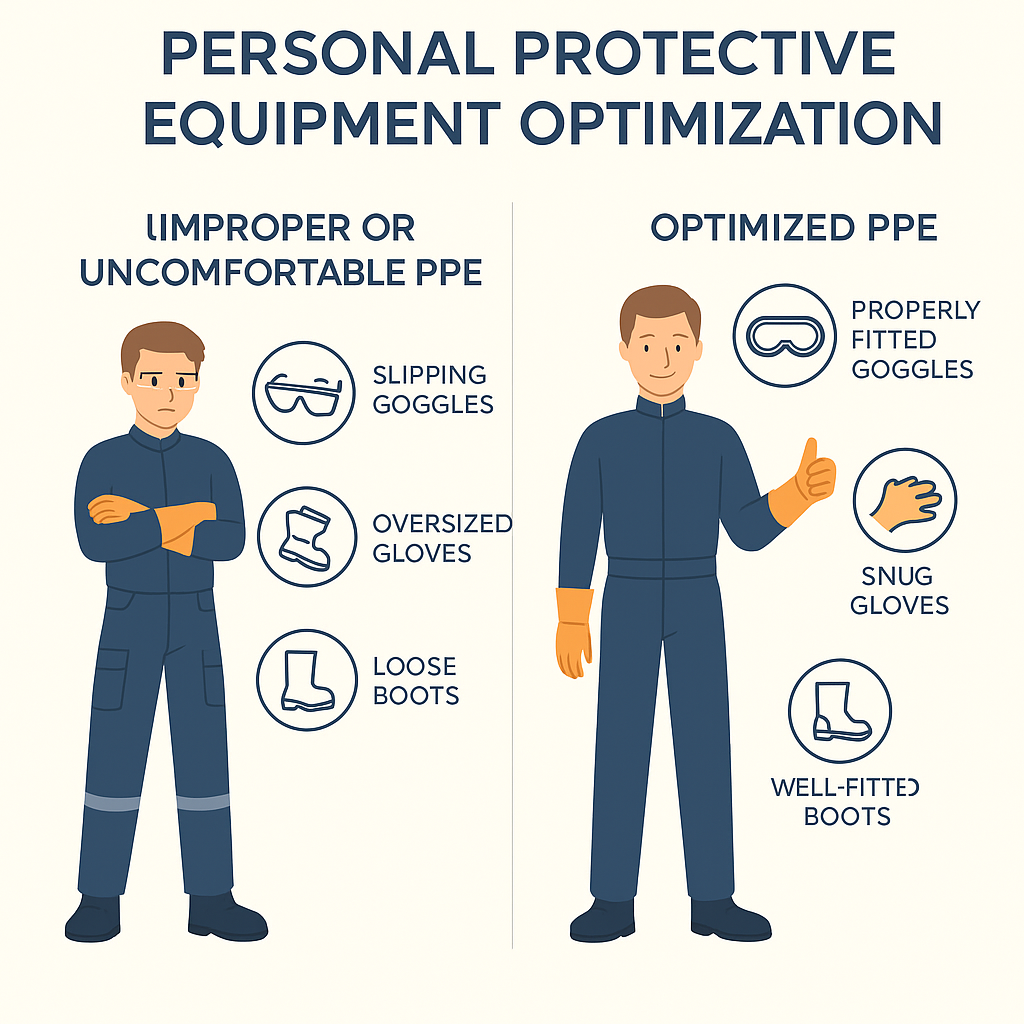
Personal Protective Equipment (PPE) – such as helmets, safety glasses, gloves, hearing protectors, and respirators – is often called the last line of defense in workplace safety. This is because other controls (elimination, engineering, administrative) should ideally reduce hazards first, and PPE is relied on to protect workers from any residual risk that remains. However, in practice, PPE is a crucial component of safety programs, especially in industries where some hazards cannot be completely engineered out. Optimizing PPE means ensuring that for every task, workers have the appropriate equipment that effectively protects against the specific hazard, without introducing unnecessary discomfort or new risks. For instance, in a chemical plant, selecting gloves resistant to the specific chemicals handled is critical (using the wrong material could give a false sense of security). In a fabrication shop, providing hearing protection with the right attenuation can prevent hearing loss without over-isolating the worker from ambient sound (like alarms). A common issue is that if PPE is uncomfortable or hinders work, employees may be reluctant to wear it consistently. Employers should therefore carefully consider fit and comfort when selecting PPE, since well-fitting, comfortable PPE is more likely to be worn properly and consistently by employees. Good PPE optimization finds that balance: maximum safety, minimum impediment.
OSVARD’s PPE optimization service begins with a hazard assessment of workplaces and tasks, as required by OSHA and most safety regulations. We identify for each job or process what hazards are present: Is there a risk of head injury from falling objects? Flying particles that could strike the eye? High noise levels? Hazardous dust or fumes that could be inhaled? Once hazards are mapped, we evaluate existing controls and determine where PPE is needed as a safeguard. The next step is selecting the right type and grade of PPE. This involves looking at standards (such as ANSI, EN, or local Thai Industrial Standards) for tested equipment. OSVARD advises on the specifics: for example, choosing cut-resistant gloves of the proper rating for handling sharp objects, or the correct filter cartridges for respirators based on chemical exposure. Optimization also means avoiding over-protection. Overly bulky or excessive PPE can cause discomfort or reduced mobility, ironically leading to non-compliance. We strive to match PPE to the hazard level – for example, providing cooling vests or breathable fabric coveralls for hot environments so workers are protected but not overheated. Another aspect is ensuring compatibility: making sure that different pieces of PPE can be worn together comfortably (a common issue is when safety glasses fog up inside a respirator or when a hardhat and earmuffs together don’t fit well). Through trials and worker feedback, we help pick PPE models and sizes that fit a diverse workforce. We remember that one size does not fit all – particularly in Asia’s workforce which can vary widely in size and shape, so having multiple size options and adjustable PPE is important.
Even the best PPE is ineffective if it’s not worn or maintained correctly. OSVARD works with clients to improve PPE compliance through training and program management. We help develop clear PPE policies that specify who needs to wear what and when, making it unambiguous (for example: “Safety goggles must be worn at all times in the chemical mixing area.”). We conduct training sessions so workers understand why the PPE is necessary, how to wear it properly, and how to care for it. When workers grasp how PPE protects them – such as learning that a certain respirator cartridge will block specific harmful vapors – they are more likely to use it diligently. We also share comfort tips (adjusting straps, cleaning visors to prevent fogging, etc.) and encourage reporting of PPE problems. If employees voice issues like “these gloves make it hard to handle small parts,” OSVARD assists in finding better alternatives – perhaps a thinner but equally protective glove. We also advise on PPE program administration: ensuring adequate supplies and replacements, proper storage (to keep PPE functional and hygienic), and inspection routines (like checking hard hats for cracks or respirators for seal integrity). Cost optimization is part of the picture too – OSVARD can help rationalize PPE inventories by standardizing on a selection of high-quality PPE that covers most needs, potentially reducing costs through bulk purchasing, while eliminating redundant or unnecessary gear. By making PPE easy to obtain and comfortable to use, and by involving employees in the selection process, companies can dramatically increase wearing rates. Ultimately, the result of PPE optimization is that workers are consistently protected when other controls might fail. This leads to fewer injuries such as eye accidents, hand lacerations, or hearing loss. It also boosts morale – employees feel that their well-being is valued when the company provides them with effective, well-fitted gear rather than cheap or cumbersome equipment.
OSHA (Hierarchy of Controls) – PPE is considered the last line of defense and should be used when higher-level controls are not sufficientnaspweb.com.
OSHA – Employers must consider fit and comfort when selecting PPE; well-fitting, comfortable PPE is more likely to be worn by employees and thus more effectiveosha.gov.
NASP – OSHA emphasizes PPE is acceptable as protection only after trying higher controls, highlighting its role as a final safeguard in preventing worker injurynaspweb.com.