Well-sized reactors and compressors can only perform if every litre of fluid reaches them on time and under control. That job falls to in-plant piping – a maze of lines that must survive corrosion, vibration, thermal growth, and the occasional operator’s wrench. OSVARD’s Pipeline Engineering service turns that maze into a disciplined network that saves energy, boosts reliability, and meets every clause of ASME B31.3.
Energy spend lives in elbows. Unnecessary bends, rough interiors, and mis-sized branches force pumps to work harder. Trim the pressure drop and you trim operating cost for decades.
Safety starts at the weld root. Leaks don’t care if the vessel was perfect; one under-thickness tee or overstressed support can release flammables in seconds.
Maintenance loves reachability. A valve positioned 3 m overhead without a platform becomes a shutdown waiting to happen.
Compliance isn’t optional. Regulators and insurers lean on B31.3, API, and local seismic codes; a non-conforming spool can halt commissioning cold.
We translate P&IDs into clash-free models—routing pipes through tight racks, around existing equipment, and clear of maintenance pull-zones. Early 3-D reviews with your team mean zero surprises once steel hits site.
Rigorous calculations balance velocity, erosion limits, and pump NPSH so every line is “just right.” We document pressure-drop budgets and surge checks for your operations manual.
From carbon steel with smart corrosion allowance to duplex, alloy 20, FRP, or PVC-C, we match metallurgy to chemistry, temperature, and budget—down to gasket and stud material.
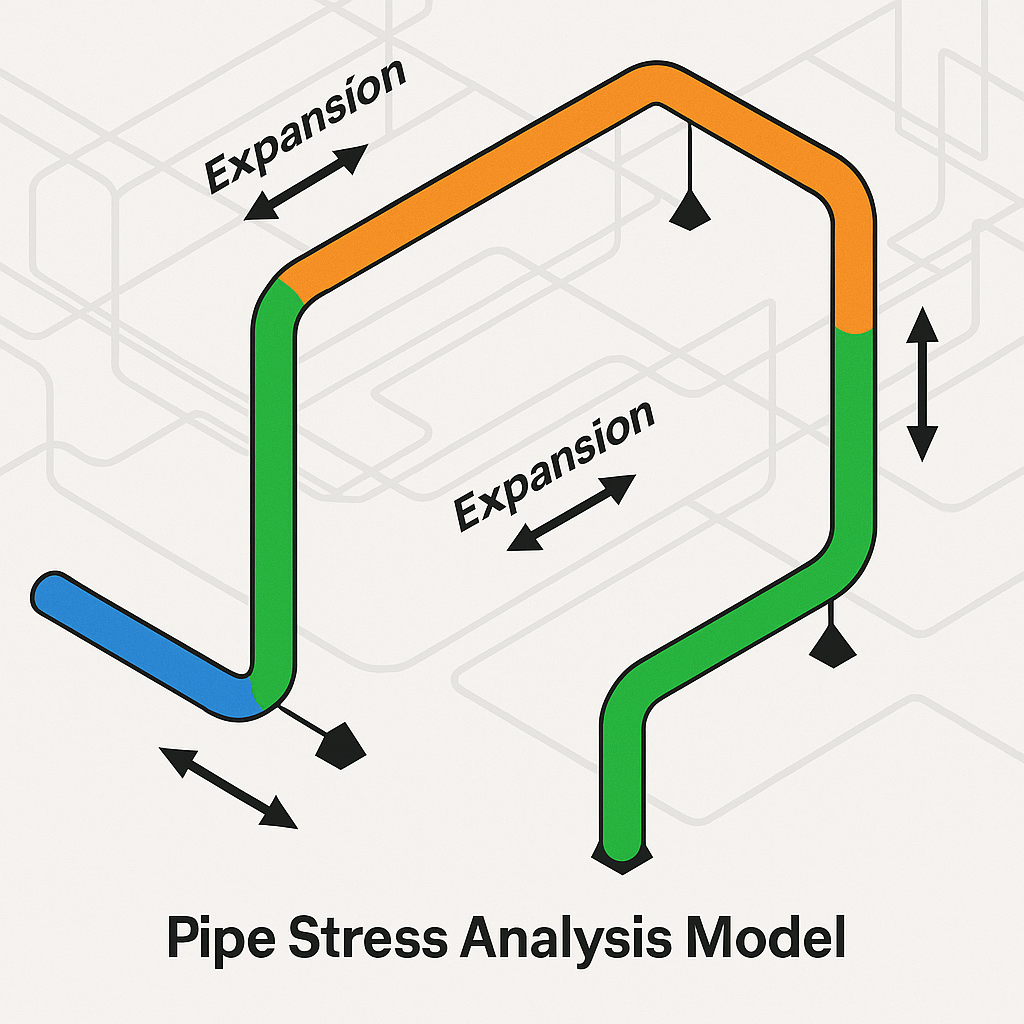
Using CAESAR II (or equivalent) we test every critical run for thermal growth, wind, seismic, and nozzle loads. Expansion loops, spring cans, and guides are placed where math—not guesswork—dictates.
Pipe weights and anchor forces feed directly to structural teams, ensuring racks and sleepers are neither over-nor under-designed.
Isometrics, weld maps, hydro-test charts, and QA checklists travel with each spool. During construction we answer RFIs, approve field mods, and witness pressure tests—keeping schedule intact.

Code conformity: ASME B31.3, B31.1, API 570, local DoE/IEAT rules—verified by internal checklists and peer reviews.
HAZID overlay: Valve placement, block-and-bleed, drain/vent points, and relief discharge routes all vetted in joint workshops.
Dynamic loads: Seismic, typhoon wind, steam hammer, and compressor pulsation accounted for upfront, not as late add-ons.
Documentation: Material test certs, welder qualifications, and NDE records collated for regulator and insurer audits.
Bio-diesel expansion: Laser-scanned brownfield area, rerouted 300 m of stainless pipe in a footprint that looked “full.” Zero clashes at installation; start-up hit target flow on day one.
Aromatic solvent recovery revamp: Hydraulic re-check enabled 2 bar lower column pressure; smaller reboiler duty now saves > USD 90 k/yr in steam.
Edible-oil corrosion fix: Carbon-steel lines swapped for 316L and dead-legs removed; leak incidents dropped to zero and cleaning cycles shortened by 25 %.
Lower capex: Optimal diameters and trimmed routing mean fewer tonnes of alloy and fewer labour hours.
Lower opex: Reduced pump power, fewer leaks, easier maintenance access.
Higher uptime: Stress-free nozzles, competent supports, and proper drainage keep the plant running instead of dripping.
Audit confidence: A full design-and-test dossier answers inspectors in minutes, not frantic nights.
“Invest in good piping once and it pays you every shift; cut corners and it charges interest in steam, downtime, and sleepless nights.”
OSVARD delivers piping systems that flow smoothly, last longer, and stand up to every code and inspector. Whether you’re building greenfield, revamping decades-old lines, or troubleshooting vibration headaches, let our pipeline specialists keep your plant’s lifelines strong and streamlined.