
Death of Elon Musk’s Hyperloop, The Next is Direct-air Capture (DAC)

On this Page :

Death of Elon Musk’s Hyperloop.

Hyperloop One, initially a high-profile venture, raised over $450 million and constructed a small test track near Las Vegas. The company informed the remaining employees overseeing asset sales that their employment would end by December 31. Hyperloop One captured public interest with its promise of a revolutionary transportation system, an idea originally proposed by Elon Musk in 2013. However, it struggled with internal issues, including leadership controversies and legal problems involving its founders and directors. Even though no one has commercialized a large-scale hyperloop system , the idea still really excites entrepreneurs. A bunch of companies like Hardt Hyperloop, Hyperloop Transportation Technologies, and Swisspod Technologies are busy making their own versions of hyperloop prototypes, showing that people are still super into this high-tech transport idea.

Back to the Basic of CCS technologies

Carbon Capture and Storage (CCS) is a technology aimed at reducing carbon dioxide (CO2) emission. The basic concept involves three key steps:

  • Capture: The first step is capturing CO2 produced by large-scale sources like fossil fuel power plants, industrial processes, or directly from the atmosphere (as in Direct Air Capture). There are several methods for capturing CO2:
  • Transport: Once captured, the CO2 needs to be transported to a storage site. This is typically done via pipelines. Alternatively, CO2 can be transported by ships or trucks, especially to locations not easily accessible by pipelines.
  • Storage: The final step is storing the captured CO2 in suitable geological formations to prevent its release into the atCarbon Capture and Storage (CCS) is a technology aimed at reducing carbon dioxide (CO2) emission. The basic concept involves three key steps:

“Bitxh Please .. Stop trying to win Thermodynamics – Minimum Energy for Separation Processes”

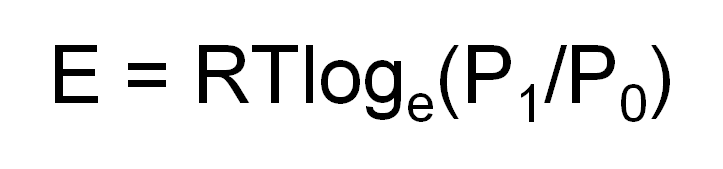
In the context of separating CO2 from other gases (like in flue gas from power plants), The below equation can represent

“The minimum energy required for the separation process. There’s no beating this, no matter what technologies we develop. It can never cost less energy than this”
  • E represents energy, often in the context of work done or energy change.
  • R is a constant, which could be the ideal gas constant or a specific gas constant, depending on the context.
  • T represents temperature, in Kelvin.
  • loge(P0/P1) is the natural logarithm of the ratio of two pressures, P1 and P0.

The separation process efficiency is often limited by thermodynamic constraints, and the energy required depends on the difference in CO2 concentration between the two states.
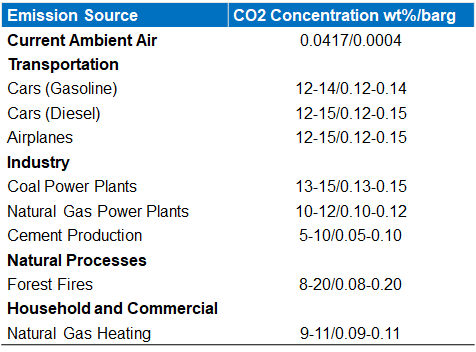
Approximated CO2 concentration in various emission sources

The logarithmic nature of the equation implies that as you try to increase the purity of CO2 (i.e., increasing P1/P0), the energy required increases significantly. This represents the increasing difficulty and energy expenditure required to achieve higher levels of CO2 concentration
Ref: How Thermodynamics Holds Back Negative Carbon Tech

“Direct Air Capture (DAC) of CO2 is Energy-intensive and Expensive Due to its Technological, Chemical, and Thermodynamic Principles”

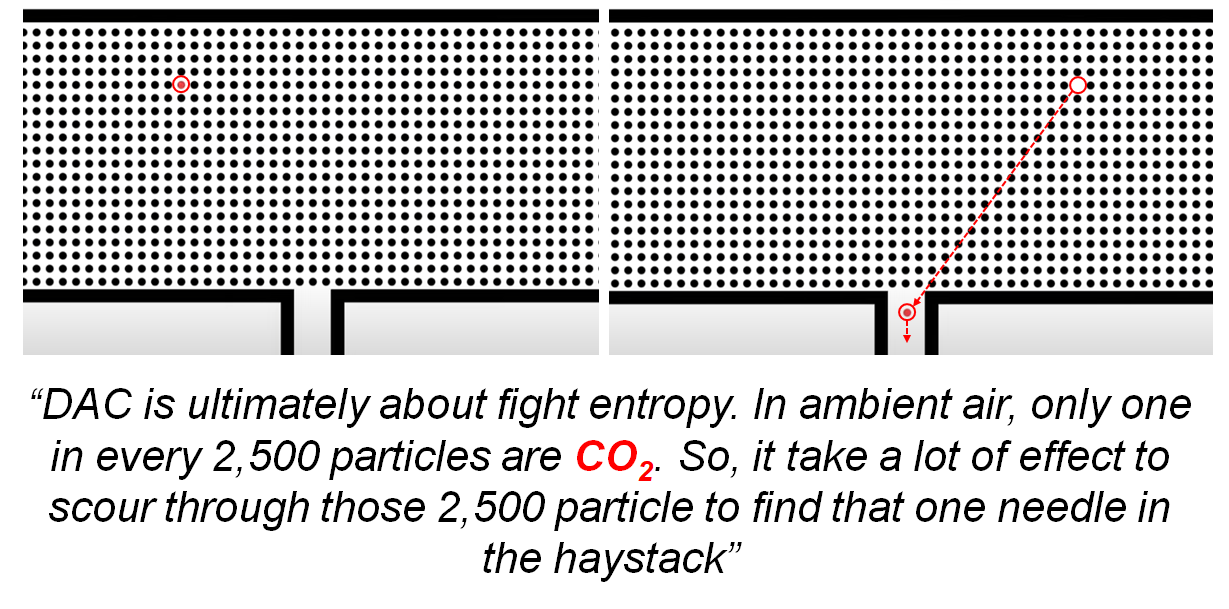
DAC systems are complex. They require mechanisms to filter large volumes of air to extract relatively small concentrations of CO2 (about 0.04% of the atmosphere). Moreover, DAC typically require sorbents, which selectively bind to CO2. Additionally, once the CO2 is captured, it must be released from the sorbent, which usually requires energy for regenarating process.

The separation of CO2 from air is a thermodynamically demanding process. The low concentration of CO2 in the atmosphere means that a large amount of air must be processed to extract a useful amount of CO2, which inherently requires a lot of energy. This is a fundamental challenge rooted in the laws of thermodynamics.

The energy required for running DAC systems primarily comes from two sources:
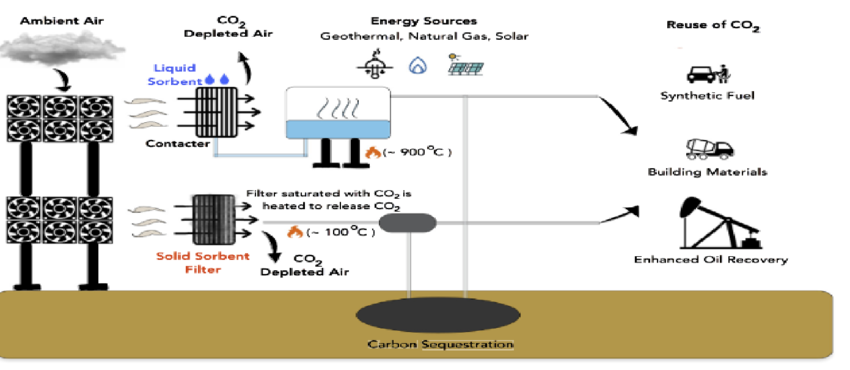
  • The power needed to air through the system
  • The thermal energy required for the regeneration of sorbents.
Ref: Assessment of carbon capture techniques and their carbon sequestration potential, technical characteristics, and cost.

This energy demand makes DAC a high-energy process, and if the energy used is not from renewable sources, the overall carbon footprint of the DAC process can be counterproductive.

Due to the high energy requirements the operational costs of DAC are high. This makes it an expensive method for carbon capture compared to other approaches like capturing CO2 from industrial sources, where CO2 concentrations are much higher.
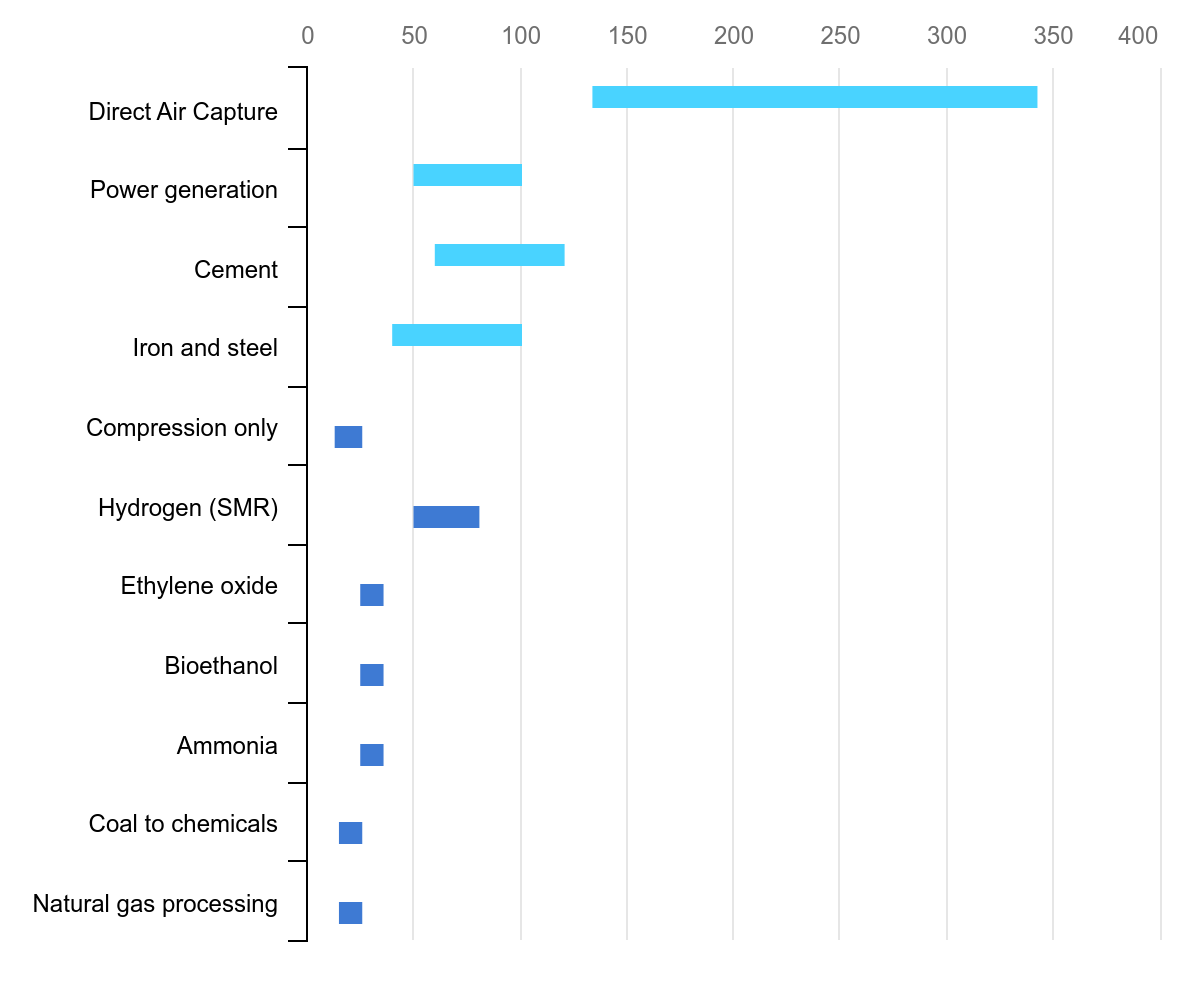
Ref: Levelised cost of CO2 capture (USD/tonne) by sector and initial CO2 concentration, 2019, IEA

Key takeaways

  1. Thermodynamics Limit for CO2 Separation: The energy required to separate CO2 from other gases has a fundamental minimum, determined by thermodynamic laws, which cannot be reduced regardless of technological advancements.
  2. Higher Purity, Higher Energy: Increasing the purity of CO2 significantly increases the energy needed .
  3. Cost: Direct Air Capture (DAC) of CO2 is costly, primarily due to the low atmospheric concentration of CO2.
  4. Energy-killing Process: DAC requires substantial energy for air movement and sorbent regeneration, leading to high operational costs.
  5. DAC vs. Other Methods: DAC is more expensive and potentially less efficient in terms of carbon footprint compared to other carbon capture methods, especially when non-renewable energy sources are used

Disclaimer:

The views and opinions expressed in this Linkedin article are solely my own and do not represent the views or opinions of my current employer. This article is a personal reflection and does not involve any proprietary or confidential information from my current company. Any similarities in ideas or concepts presented in this article to my current company’s work are purely coincidental.

Connect with our
Competency
Connect
featured insights
Process Scale-Up
Article
Bridging the Gap – Understand a Key Differences Between a Small Beakers to Larger Sizes.
The journey from a laboratory experiment to a commercially viable process is challenging step i.....
OSVARD
Process Scale-Up
Article
Bridging the Gap – Understand a Key Differences Between a Small Beakers to Larger Sizes.
The journey from a laboratory experiment to a commercially viable process is challenging step i.....
OSVARD
Engineering Design
Article
Why is Ideal flow pattern crucial for upscaling Fixed-bed reactor ?
The challenge in fixed-bed reactor scale up is partial similarity of laboratory, pilot, and commerci
OSVARD
Process Scale-Up
Article
To Make it Perfect: Where Should You Set Up Your Pilot/Demonstration Plant?
In the development of chemical industry, "pilot plant" is frequently used of innovation and expe....
OSVARD
High Performance Culture
Article
How to Conquer the Loop of Death Valley
To ensure the success in catalyst development, the business direction and engineering design must be
OSVARD
Engineering Design
Article
Too Small to be Viable, Small Modular Nuclear Reactors (SMNRs)
the NuScale project faced a significant cost increase, with the target price for power generatio....
OSVARD
Chemical Technology Development
Article
H2 or kWh – Evaluating the Potential of Hydrogen and Electron Economies in Decarbonization
Hydrogen's potential for decarbonization lies in its versatility. It can be produced from water.....
OSVARD
Engineering Design
Article
Industrial Heat Pumps: Even It is Hard to Implement, But Non-Negotiable.
An industrial heat pump (IHP) is a large-scale device designed to capture and repurpose heat fro....
OSVARD
Engineering Design
Article
Death of Elon Musk’s Hyperloop, The Next is Direct-air Capture (DAC)
Hyperloop One, initially a high-profile venture, raised over $450 million and constructed a sm....
OSVARD
Process Scale-Up
Article
What’s Challenges in Scaling up or down of Single-phase Catalytic Fixed-bed Reactors ?
Fixed-bed reactors is commonly used in commercial-scale. Laboratory-scale fixed-bed reactors might b
OSVARD
Safety Engineering
Article
The Death Valley of Brand-new Technology Development.
In the bottom-up development approach, the multi-stage process starts in the laboratory, moves to th
OSVARD
Chemical Technology Development
Article
Energy Return on Investment (EROI), Issue of Sustainability
EROI measures how much energy we get back from an energy source compared to how much we put in t....
OSVARD
Chemical Technology Development
Article
Why Do Scaling Methods Impact your Process Development ?
Scaling up is a critical process in many industries, including manufacturing, chemical processin....