Replacing a novel catalyst into an existing industrial operation is not easy task, requiring comprehensive information about various aspects, including:
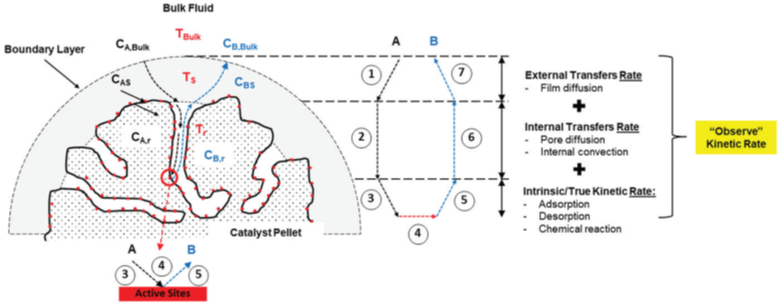
• Reaction kinetics and kinetic models
• Catalyst activity and selectivity
• Catalyst pretreatment protocols
• Catalyst deactivation kinetics, lifespan, and regeneration
• Safety concerns in the event of industrial accidents
Key critical concern that you need to consider when replacing better catalyst
Several key factors should be considered when replacing a catalyst as example:
- Ensure your agreement between you and existing technology provider in order to avoid conflicts.
- The kinetic behavior may differ even with a similar composition to the existing catalyst.
- The new catalyst might generate unexpected impurities, raising concerns for the existing unit. Additional pretreatment, such as guard beds or wastewater treatment, may be necessary.
- Existing commercial units have specific operating ranges, potentially excluding a your better catalyst if its optimal conditions fall outside this range.
- Feasibility is crucial in determining the suitability of an improved catalyst.
The Guideline
- Understand the existing process and catalyst: Investigate the existing process, reaction mechanism, catalyst role, composition, structure, properties, limitations, and disadvantages.
- Establish development objectives: Define catalyst improvement goals, such as increased activity, selectivity, stability, regenability, or cost reduction.
- Save time on catalyst screening through literature review: Research recent advancements in catalyst design for similar processes or applications to identify novel materials, structures, or strategies applicable to your process.
- Explore and test potential materials: Investigate new or modified materials that could achieve your objectives. Evaluate the improved catalyst’s performance under desired reaction conditions and compare the results with the existing catalyst.
- Identify critical characteristics of your catalyst: Use analytical techniques to determine essential properties such as surface area, pore size distribution, phases, and crystallite size.
- Investigate optimal reaction conditions: Examine the influence of temperature, pressure, reactant concentration, and other reaction parameters on catalyst performance. Optimize these conditions to maximize the improved catalyst’s performance while considering the existing unit’s constraints.
- Compare the feasibility of existing and new catalysts: Feasibility is a determining factor in selecting an improved catalyst.
- Investigate viable catalyst production methods: Experiment with various synthesis techniques at the lab scale, such as sol-gel, precipitation, impregnation, or chemical vapor deposition, to enhance catalyst properties. Then, explore scaling up production with a catalyst toller.
- Scale-up: Identify a promising catalyst candidate, scale up its synthesis, and test its performance in larger-scale or pilot plant reactors to ensure real-world effectiveness.
- Assess implementation: Evaluate the new catalyst’s impact on the existing commercial unit, identifying potential trade-offs and ensuring that improvements do not inadvertently affect the overall process.
Remember that replacing a new better catalyst is not easy process that may not only require technological success, collaborating with experts in catalysis, and process engineering, but also consider non-technical problem such as your agreement with exisitng technology provider.