
Understanding about “Levelized Cost of Energy (LCOE): What should we know, what should we do?

On this Page :

Accelerating decarbonization has been focused on our world. Numerous companies deploy their ambitions, direction, etc. about how they do (sometime not do), what they are. Many renewable energy projects have been developed (Nuclear, Wind, Solar, etc.) in different stages frequently measured using indicating things such as TRL combined with feasibility study.

Why is LCOE important?

Roughly comparing energy projects, Levelized cost of energy (LCOE) has been popular for providing the preliminary benchmarking that it is a useful tool for policy makers, investors, and energy companies to evaluate the costs and benefits of different energy sources and methods, which make simply and quickly decisions about the deployment of energy generation technologies.

What is the definition of LCOE and How do we calculate it?

Levelized cost of energy (LCOE) is the indicator to measure the average total cost of generating energy from a specific source over total electricity generation over its lifetime.

LCOE = [Net present value (NPV) of total cost of the energy-generating system over lifetime] / [Net present value (NPV) of Total energy produced over the lifetime of the system]

“Net present value (NPV) of total cost of the energy-generating system over lifetime” could be calculated following simple factors:
  • Investment expenditures in year t.
  • Running expenditures (Operation, maintenance, Fuel, etc.) in year t
  • Financing expenditures, including interest, discount rate, etc.
No alt text provided for this image
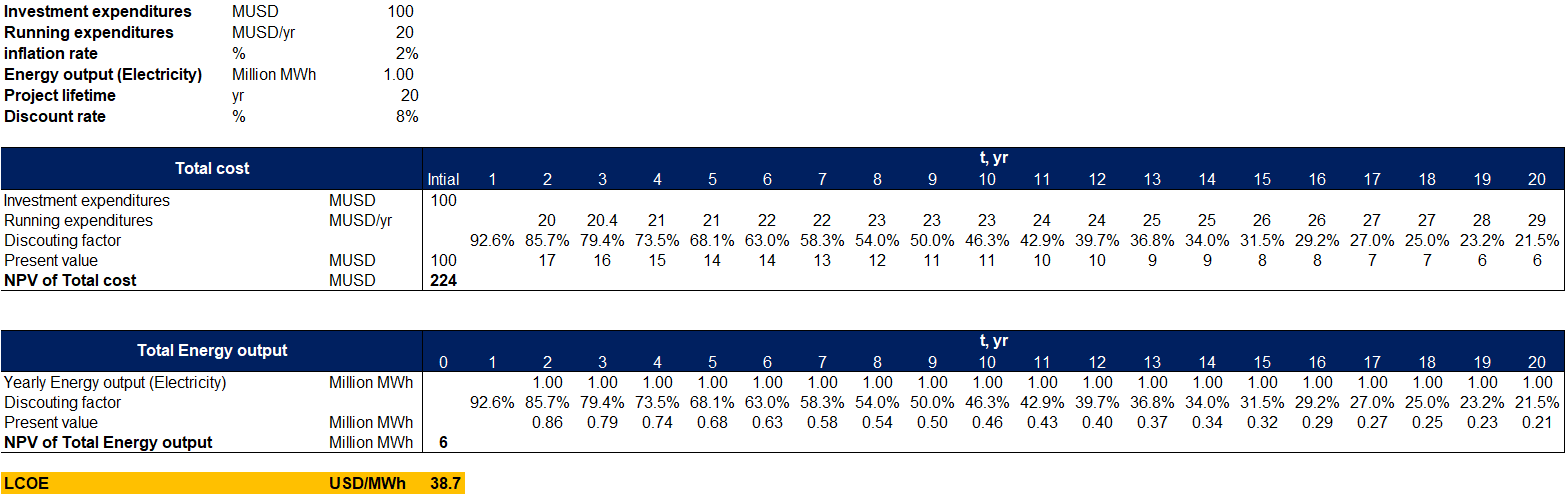
Levelized Cost of Energy: Calculation example

There are two major LCOE methods are used:

  1. LCOE annuitizing method: suggested by National Renewable Energy Laboratory (NREL)
  2. LCOE discounting method: suggested by Department for Business, Energy & Industrial Strategy

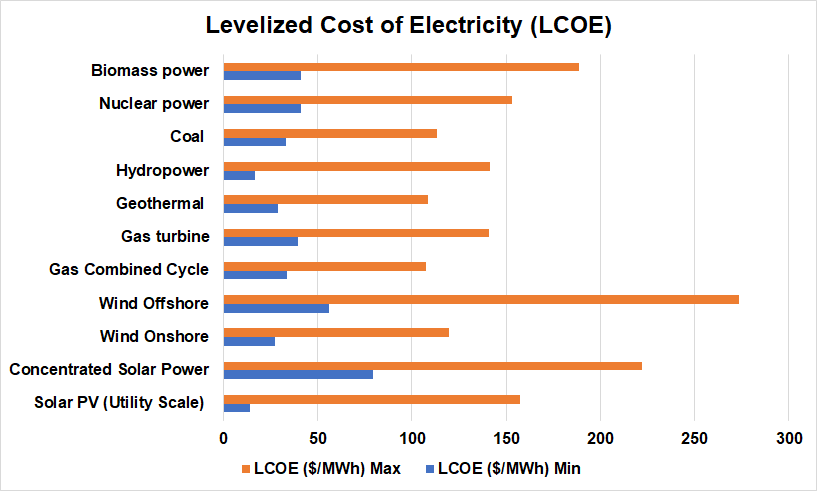
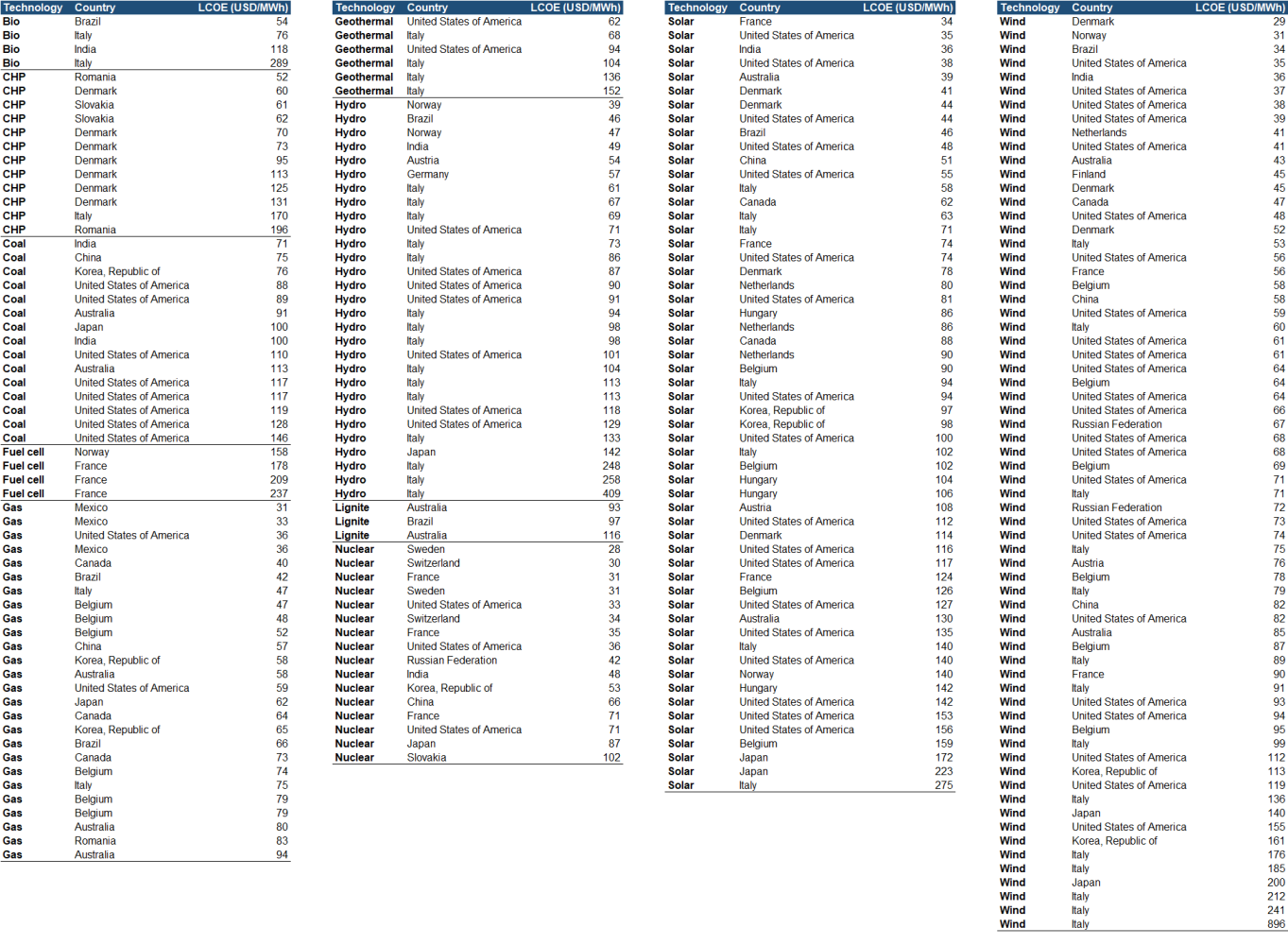
Some of LCOE Report and Study

No alt text provided for this image
Ref: ““Demystifying the Costs of Electricity Generation Technologies”. World Bank Policy Research Working Paper, WPS 9303. World Bank Washington, DC. “
No alt text provided for this image
Ref:”Projected Costs of Generating Electricity 2020″

LCOE: Disadvantage

  • Oversimplify: LCOE provides summarized value from a complex set of costs and benefits, we need to detail analysis in different energy sources.
  • Neglect external factors: LCOE does not consider external costs and benefits, such as environmental impacts, greenhouse gas emissions, or the impact on local ecosystems.
  • High uncertainty: LCOE calculations do not include uncertainties that can be changed over time.
  • Different calculation methods: There is no standard method for calculating LCOE, and different organizations may use different methods and assumptions, making it difficult to compare the LCOE of different energy sources.
  • Restrictive scope: LCOE does not consider the cost of energy transmission, distribution, or storage.

Connect with our
Competency
Connect
featured insights
Process Scale-Up
Article
Bridging the Gap – Understand a Key Differences Between a Small Beakers to Larger Sizes.
The journey from a laboratory experiment to a commercially viable process is challenging step i.....
OSVARD
Process Scale-Up
Article
Bridging the Gap – Understand a Key Differences Between a Small Beakers to Larger Sizes.
The journey from a laboratory experiment to a commercially viable process is challenging step i.....
OSVARD
Engineering Design
Article
Why is Ideal flow pattern crucial for upscaling Fixed-bed reactor ?
The challenge in fixed-bed reactor scale up is partial similarity of laboratory, pilot, and commerci
OSVARD
Chemical Technology Development
Article
Energy Return on Investment (EROI), Issue of Sustainability
EROI measures how much energy we get back from an energy source compared to how much we put in t....
OSVARD
Chemical Technology Development
Article
Why Do Scaling Methods Impact your Process Development ?
Scaling up is a critical process in many industries, including manufacturing, chemical processin....
OSVARD
Process Scale-Up
Article
Strategies for Reducing Cost and Schedules in Pilot Plants
Reducing capital costs and schedules in pilot and demonstration plants is crucial for the succe.....
OSVARD
Chemical Technology Development
Article
10 Common belief but False Idea on Net Zero Emission
People often interpret "Net Zero" as an end state where no emissions are being produced at all. This
OSVARD
Process Scale-Up
Article
What are Main Differences between Lab, Pilot, Demonstration and Commercial Plant in A Nutshell ?
Nowadays, many companies have been constantly transforming from production-and operation-based compa
OSVARD
Chemical Technology Development
Article
The Key Concern with Biofuels
Biofuels like ethanol and biodiesel have been getting a lot of attention. Ethanol is often mixed....
OSVARD
Chemical Technology Development
Article
A Practical Guide to Create a Reasonable Marketing Plan for Chemical Technologies
For natural scientists and engineers, it sometimes might be difficult to become with marketing, ....
OSVARD
Engineering Design
Article
Unraveling the Mystery of Catalyst Deactivation: The Hidden Challenges in Catalyst Development
Catalyst deactivation, the process whereby a catalyst loses its catalytic activity and/or select....
OSVARD
Simulation and Digitalization
Article
Scaling the CCS: What are Technical Challenges ?
Carbon Capture and Storage (CCS) is a technology for reducing carbon dioxide (CO2) from various emii
OSVARD
Safety Engineering
Article
Ensuring isothermality is important in lab and pilot-scale tests.
In catalyst development, laboratory and pilot plant are generally used for producing reliable inform