
Nowadays, many companies have been constantly transforming from production-and operation-based company to technology-providing company in order to gain an advantage in the modern market. customer needs are importance. Therefore, these companies realize that the importance of investing in research & development & engineering (R&D&E) are crucial. For reason, high-volume production is indispensable. Knowledge of scaling up from the small beaker to the commercial production becomes importance. Large-scale production, especially in new products, it is very difficult to avoid testing and trialing between the laboratory and commercial scale, known as pilot plants and demonstration plants.
1st Difference: Main Objective
In commercial-scale production, main reasons often are to maximize profit, minimize total investment, operate process with high reliability & safety, and achieve economies of scale. On the other hand, laboratory research is completely different for commercial-scale production, because main goals are exploring, screening, benchmarking new products with existing technology, regardless focusing on production that make a profit. Therefore, equipment and operation might be different from the commercial-scale production. Moreover, there are various constraints that make it difficult to apply standard of commercial scale to design lab scale consistently.
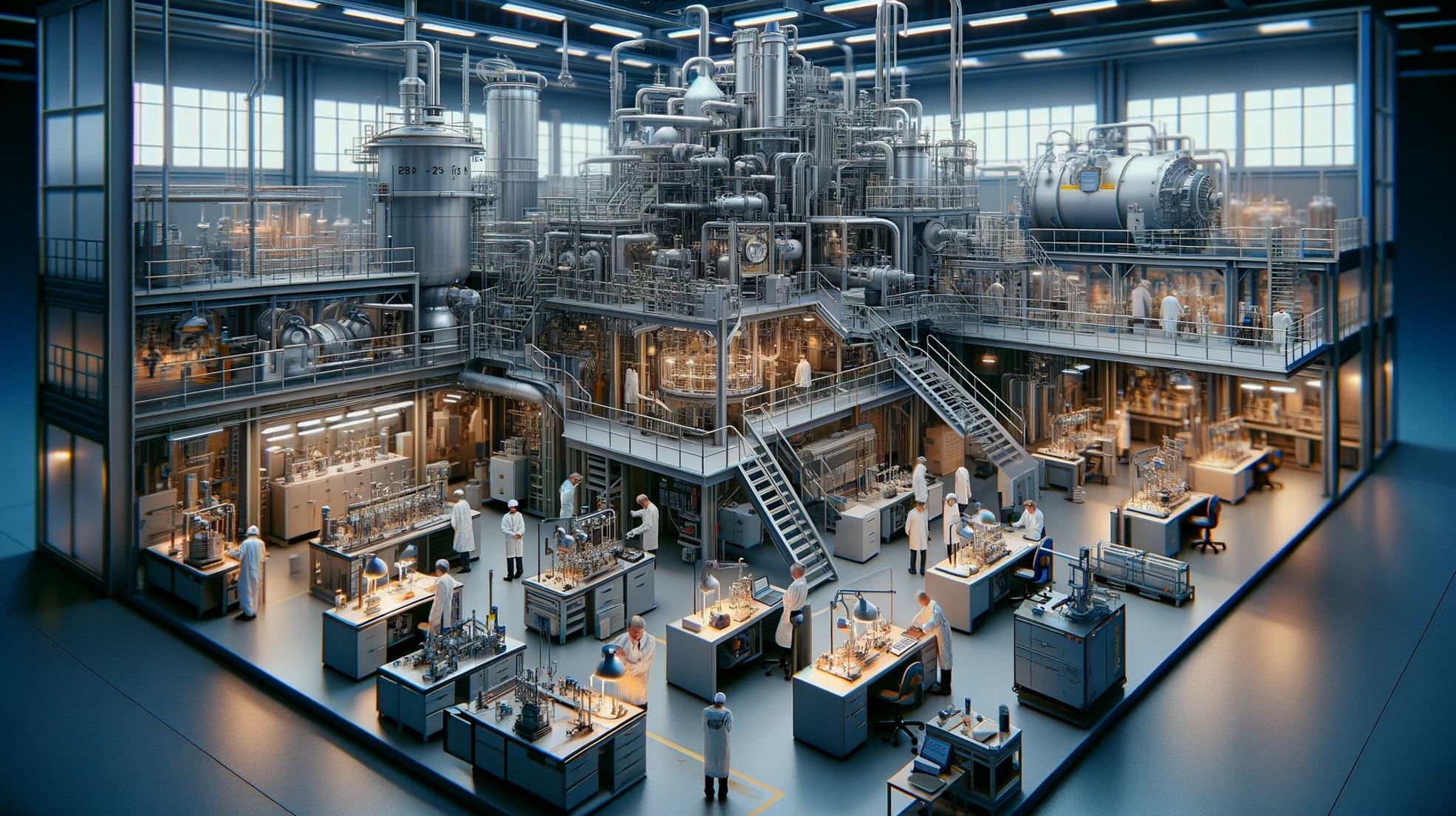
When starting to scaleup, pilot plants are often considered as the first option, especially in improvement of existing process that can be completed in this scale. Other words, pilot plant is carried out additional/specified experiment to confirm some critical phenomena where laboratory-scale experiment is not feasible or virtual.
Generally, the demonstration plant is usually used to provide confident information. In the case of a new or novel process/equipment, demonstration plant could generate specified procedure, inspire confidential in management & customer, and product sample for marketing test.
2nd Difference: General Operating Condition
For a large-scale production, selection of the type and quality of feedstock is very important. It is necessary to select wider range of acceptable quality of feedstock (minimize cost of feedstock). If catalyst is required, it might be in tons-scale catalyst used. Continuous operation is general, because the cost of startup and shutdown are very expensive (continually operate without unnecessary downtime).
High flexibilities in laboratory scale is essential for producing new products, features, functions are required. Experiment should be started up shutdown easily in order to increase the number of trials per unit time advantage. Synthetic or/and simulated real feeds are sometime used for specific experiments (effect of recycle, etc.) For experimental conditions, it is generally preferable to be carried out in constant of temperature and pressure (Isothermal & isobaric) due to limitations of equipment.
Pilot plant can be almost operated similarity to commercial-scale conditions because of some tools, equipment and location being convenient, which it can generate more realistically operational than laboratory). Pilot plant still allows smoothly startup and shutdown. In addition, pilot plant might be often built in/around commercial plant, research centers located near factories. Real reactants are actually easy to transport and high availability. Therefore, pilot plant can be operated continuously for months. However, it still has to operate in constant temperature and pressure conditions.