
Scaling up !!! Scaling out ??
Scaling up is a critical process in many industries, including manufacturing, chemical processing, and information technology. It involves increasing the capacity of a system to accommodate higher demand or to improve efficiency. There are generally two strategies for scaling up: vertical and horizontal. Vertical scale-up, also known as “Scaling up,” involves enhancing the capabilities of an existing system, such as upgrading a machine or server to a more powerful model. On the other hand, horizontal scale-up, often called “Scaling out,” involves increasing capacity by adding more units of the same kind. Both strategies have their own advantages and challenges, and the choice between them depends on a variety of factors, including the specific needs of the process, the available resources, and the constraints of the situation.
What are their differences ?
Vertical and horizontal scale-ups refer to two general strategies used in industry. The specific meanings can vary depending on the context, but a basic comparison is provided below:
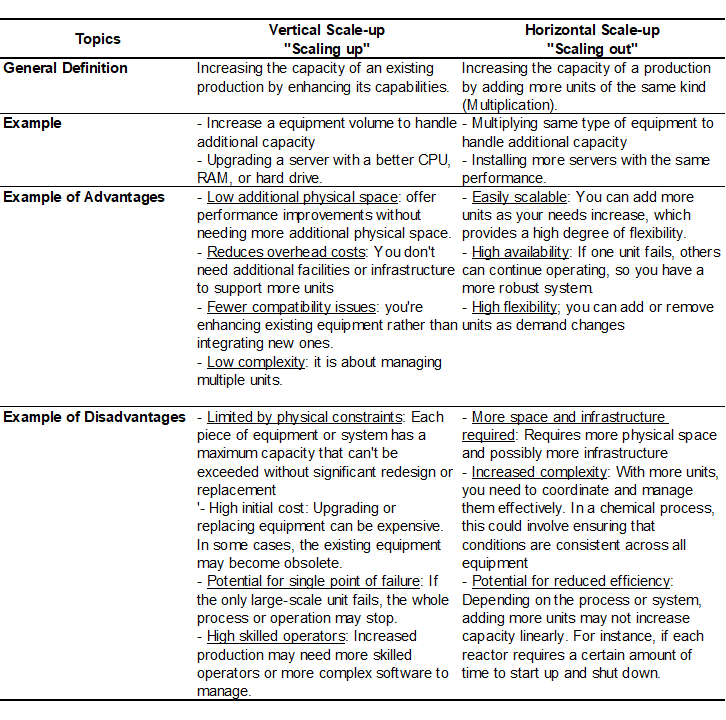
Aspects of vertical and horizontal scale-up strategies: Which should we choose ?
The best selection might depend on many factors, but the below criterias should be considered
1) Technology Limitations
Some technologies may favor one type of scale-up over the other. For example, certain types of reactions or separations might not scale up well vertically due to limitations in heat transfer, mixing, or other factors such as Food and Beverage Industry, Pharmaceuticals, etc.
2) Future Capacity Expansion
When planning a scale-up, it’s important to consider future needs. For instance, vertical scale-up might be a good option if you expect your needs to remain relatively low space, while horizontal scale-up can offer more flexibility if you expect your needs to continue high flexibility. Importantly, consider the ease or difficulty of transitioning from one scale-up method to another if needs change in the future. If you initially choose a horizontal scale-up strategy but later find that a vertical scale-up would be more beneficial, consider how difficult it would be to switch strategies.
3) Economic factors
The selection between two scale-up strategies can also be influenced by economic factors. For instance, the cost of land and infrastructure might make horizontal scale-up expensive in some areas, while high labor costs might make vertical scale-up more attractive because larger units often require less labor per unit of output.
4) Process Integration, Optimization, Control and Consistency
In vertical scale-up, integrating a larger unit into an existing process can sometimes be challenging. You may need to adjust other parts of the process to accommodate the increased throughput. On the other hand, in horizontal scale-up, it’s important to optimize the process to ensure smooth operation of all unit that you might need to redesign the workflow, etc.
When you add more units (horizontal scale-up), maintaining consistency across all units can be a challenge. For example, in a pharmaceuticals, slight variations in operating conditions can cause variations in product quality. Therefore, sophisticated control systems might be required to ensure consistent operating conditions across all units
5) Environmental Impact
Depending on the specific context, both vertical and horizontal scale-ups could have different environmental implications. For instance, a larger unit may allow for more efficient energy use or waste management than multiple smaller units. On the other hand, if a failure occurs, a larger unit may pose a greater risk of environmental contamination.
6) Human Resources:
Vertical scale-up might require more specialized skills for operating and maintaining larger or more complex equipment, which could influence training needs or hiring practices. Horizontal scale-up might necessitate more personnel to manage and maintain the increased number of units.
At this point, the major points related to vertical and horizontal scale-up strategies, including the technical, operational, financial, regulatory, and environmental considerations, as well as the impacts on human resources, innovation, risk management, and future adaptability, might be covered. you can find typical scaling methods use in different industries

Summary
Remember that the decision to scale horizontally and vertically will depend on a multitude of factors, including the specifics of the process, the scalability of the technology, the available resources, the nature of the operation, the technical feasibility, and the potential benefits and drawbacks.